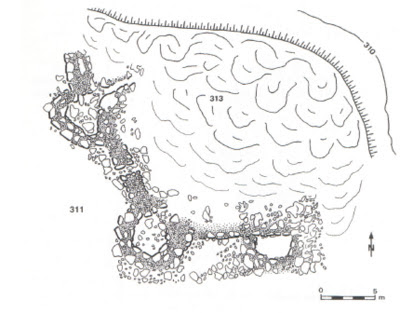
When we are “prospecting” in Google Earth it is easy
to inadvertently cross the border. That happened recently to Tiago and he just
bumped into (most probably) new ditched enclosures in the Spanish side of the
border. At least one look likes the Portuguese sinuous patterned ones, like
Xancra, Outeiro Alto or Santa Vitória. If so, they are the first ones of this
typology to be recognized in Spain.
Friday, June 28, 2013
Friday, June 21, 2013
0193 – Solstice day
Today is the Summer solstice.
The inner enclosure of Santa Vitória is one of the Portuguese
ditched enclosures that had the gate (the only gate) aligned with the sunrise in
this day. It must have been a special day there, some 4500 years ago.
Etiquetas:
aa_Ditched enclosures,
Archaeoastronomy,
Architecture,
Santa Vitória
Sunday, June 16, 2013
0192 – Enclosures and cromlechs
Cromlech of Almendres, near Évora
There are several parallels that can be established
between ditched enclosures and cromlechs in South Portugal Late Neolithic. Not
just some cromlechs show a topographical implantation and relations with the
landscape similar to several ditched enclosures, like being in a slope
orientated to East and with relation to sun events (like Vale Maria do Meio or
Almendres), but others seem to be in close spatial relation with ditched
enclosures. That can be seen at Torrão and Perdigões.
Neolithic Perdigões: the strong black lines mark the known (at the moment) Neolithic structures.
In Torrão the cromlech is just outside the Late
Neolithic ditch and in Perdigões is a couple of hundred meters to the East of
the early ditches also dated from Late Neolithic. In both sites there aren´t
yet empirical evidences that directly connect the enclosures to the cromlechs,
but being totally contemporary or not, the general idea that we get from the
location and orientation of several Neolithic cromlechs and ditched enclosures,
and from the proximity that some of them present, is that there is an
ideological connection between them and that they, being different, respond to same
shared general principles.
There seems to be a strong link between some ditched enclosures
and some megalithic structures in Alentejo, as complementary means of
expressing and organizing Neolithic world views and landscapes.
We have several Neolithic cromlechs in the region. Besides
Torrão and Perdigões, I wonder how many have an unrevealed ditched enclosure nearby.
Etiquetas:
aa_Ditched enclosures,
Architecture,
General issues,
Perdigões,
Torrão
Monday, June 10, 2013
0191 – Displaying Perdigões
It is not a proper museum. Is more like a small
exhibition that function as an interpretation centre. It opened in 2004, in the
medieval tower of Esporão, and is one of the two exhibitions specifically
dedicated to prehistoric ditched enclosures in Portugal (the other one is in
Alcalar, Algarve).
I was involved in the conception of that exhibition.
And I am not comfortable with it anymore. In the last nine years the research
in Perdigões has increased and what we know now is not reflected in that
exhibition. But, even so, a visit will give a fair notion of the site and of
its importance for the understanding of Neolithic and Chalcolithic communities
of the region.
Some updating is expected this year. But what I would
like to stress is that this effort of display is totally financed by private initiative,
by the company who ones the site (Esporão S.A.) and by the company who is
leading its research program (Era), although public support also exist for
research.
This is a project that reaches the age of 15 this
year. Slowly, it has grown to become one of the most important projects of
Portuguese archaeology, with national and international expression.
In this weekend there was another moment of public
display. It was in the “Festa da Arqueologia” that took place in the ruins of
Carmo convent (the headquarters of the Portuguese Association of
Archaeologists). There, ideas were shared and the problems of public display debated.
Etiquetas:
aa_Ditched enclosures,
Perdigões,
Public
Friday, June 7, 2013
0190 – Outeiro Alto 2
Here is a plan and a section of Outeiro Alto 2.
A paper about this site, just dated from the third quarter of the 3rd millennium BC, is being finished and it will be published soon.
Wednesday, June 5, 2013
0189 - The (i)logic ditches
Sometimes it is not easy to understand the options of
prehistoric people. In fact I would say that is not just sometimes. But that
depends on the ability that we have to dialogue “with them”.
Why ditch 7, opened after ditch 8, is more concentric to previous ditch 6 than ditch 8? Why ditch 7 develops a path that is different but, in a specific area, cuts (and probably uses) the previous ditch 8? Why are they so close to each other in certain areas and so apart in others?
Modern functional explanations fail to answer these
questions. Not because they are just “functional” explanations, but, perhaps, because
they are just too simplistic.
For instance, let’s look at a specific situation at
Perdigões.
Why ditch 7, opened after ditch 8, is more concentric to previous ditch 6 than ditch 8? Why ditch 7 develops a path that is different but, in a specific area, cuts (and probably uses) the previous ditch 8? Why are they so close to each other in certain areas and so apart in others?
That is the amazing thing about the plans provided by
geophysics. If we look carefully to the plans we find a lot “food for thought”
about the nature of enclosures. “Food” that might help us to make conscience
of the bizarre that the “definitive discourse” keeps missing.
Etiquetas:
aa_Ditched enclosures,
Architecture,
Perdigões
Friday, May 31, 2013
0188 - The importance of gates
Gates (or doors) are extraordinary important in any
architecture or space organization. Being a building (with gates or doors),
being a landscape (with its locals of passage that tradition preserved as
“Portelas”, a Latin word, or “Alvalade”, an Arab one). They are that specific
point where people cross borders between different meaningful scenarios, places
of transition, elements of orientation for pathways and mental reference in
construction of space, places to be defended or to be decorated or monumentalized.
They are so in the present and they were so in the past.
To ditched enclosures gates are a special issue, for
they can provide us with important information about the ideological background
that informed the construction of these sites. Namely, the gates show, in
several cases, in Portugal as in Europe, that these enclosures were built with
astronomic specific orientations, where gates played an important role: they are
facing important astronomic events, like the solstices or equinoxes.
We do not have in Portugal many enclosures where we
have information about the gates. We have that information for Perdigões, for
the sites of the project of geophysics that I developed in the context of my
NIA-ERA activity, for Santa Vitória, Outeiro Alto 2 and for a section of Alcalar.
I presented some of the architecture of those gates in an earlier post, where the
above image was posted.
Recintos de Bela Vista 5
Recently, in Senhora da Alegria was excavated another
strange gate (posted here) and after, in Bela Vista 5, three new gates could be
recorded. And although this is a latter enclosure, built in the last quarter of
the 3rd millennium, it seems to use gates in a way that we can track
to earlier moments in Chalcolithic: one is orientated to the sunset in the equinoxes,
and the two others are orientated to Summer solstice. And one has a semicircular
development by the outside (the “pinças de carangueijo”) similar to several
solutions we can observe in Perdigões, Moreiros 2 or Xancra, but at the same
time different: coming out of the ditch before the entrance interruption, it stops
exactly where the gate begins, not blocking a front entrance or visibility and does not create a lateral entrance as it happens in the other quoted examples.
It’s a clear example that these outside elements of
gates respond to intentions that are not easy to understand in their specific
motivations.
Etiquetas:
aa_Ditched enclosures,
Archaeoastronomy,
Bela Vista 5,
gates
Tuesday, May 28, 2013
0187 - Castro de Santiago also at the museum
Castro de Santiago walled enclosure was the first site
I excavated in Fornos de Algodres, from 1988 to 1996 and in 2006. As Fraga da
Pena, the site is displayed in the local archaeological museum. Here are the
posters that can be seen there.
I call your attention to the last one. To a specific
situation, where Santiago is an interesting case: the presence of all “chaine
operatoire” for the production, use and reuse of polished stone tools.
Etiquetas:
aa_Walled enclosures,
Castro de Santiago,
Public
Saturday, May 25, 2013
0186 – Fraga da Pena in the museum
These are the posters referring Fraga da Pena
presented at the small museum of archaeology in Fornos de Algodres, the
municipality of the site.
There, some archaeological materials from this walled
enclosure are shown and the architecture of the site is explained.
Tuesday, May 21, 2013
0185 – “Structured depositions” in pits and ditches
Porto Torrão ditched enclosure. Exacavation of ERA Arqueologia in 2002 (Valera & Filipe, 2004)
This is an issue present in every ditched enclosure, not only related to
the ditch fillings, but also to the pit ones.
There, we can frequently find totally articulated bodies, articulated
parts of bodies or scattered bones of animals (or humans). The question, for some
time now is always the same: “Is it ritual or rubbish?” (Hill, 1996)
An example is the
depositions of some animal bones in a pit between two ditches at Porto Torrão
(Valera & Filipe, 2004). There some jaws of different animals and part of a
horse limb in anatomical connection were recorded between several small stones.
“Is it ritual or rubbish?”
Porto Torrão ditched enclosure. Exacavation of ERA Arqueologia in 2002 (Valera & Filipe, 2004)
The problem here is
the traditional difficulty of dealing with human intention in Prehistoric
Archaeology and the debate around the expression “structured depositions”.
This expression has
been used to fill a semantic emptiness that results from the critics to the use
of the modern concept of garbage applied to these contexts. That criticism is
supported in the idea that what is today not sacred and understood as waste in
a mechanical negligible way, without meaning, might, in different social contexts
be of profound significance. Then, structure deposition is a concept that
emerges to avoid an impetuous projection of modern reference systems to the
past, allowing other reasons to emerge. Nevertheless, as Olsen (2000) stresses,
it tells us little about those reasons.
The questions
remains; what means an articulated limb of a horse in a pit, associated to two
jaws (of a pig and of a possible sheep)?
Recently, taking into consideration the association of animal limbs to
human funerary contexts, I and a colleague argued around a possible answer
(Valera & Costa, in press):
“Because
of these particular ontological frames, archaeology should pay equal attention
to animal remains as it does to human remains in archaeological survey (Olsen
2000): orientation, position, represented parts of the body, conditions of
those parts, individual attributes (e.g. age, gender, size, pathologies) and
contextual associations. Only then will it be possible to detect patterns that
allow us a glimpse into their world view that are not restricted to simple
economics.
In this context the abundance of limbs or
parts of limbs stresses the importance of segmentation, also present in
practices involving human bodies, certain categories of artefacts and even the
communities, so appropriately called segmentary societies. Segmentation seems to be a social strategy of
significant importance to societies in Recent Prehistory (Valera 2010).
The problem of segmentation is related to the
problem of the relation between the part and the whole, and to the different
value attributed to the degrees of physical integrality developed in different
mental frames. As J. Chapman (Chapman 2000; Chapman & Gaydarska 2007)
argued for the fragments of artefacts, we consider that the part and the whole
may assume the same symbolic role (through an ontological parity), allowing
that the part, by participating of the essence of the whole, to play the social
role of maintaining connection between people or between people and places or
events. When a part is present, that does not necessarily mean the occurrence
of post depositional activities that disordered the original context. On
contrary, we must consider the possibility of an intentional segmentation and
that the part was deposited as so. But because of the principle of
psychological participation, that part (a fragment of a pot, a paw of an
animal) may be evocative of bonds between persons and events. For instance, to
a ceremony involving the burial, to previous events that were important to the
group, even to events to happen in the future or maintaining bonds to the
social role and power of an object or animal.
As argued elsewhere (Valera 2008), this is a
cognitive mechanism where the psychological principle of participation works
allowing essential properties of the whole to be participated by the part,
establishing a homology between them. It is the principle of the sacred water,
where each segment represents the whole body of Christ and not a part of it.
Segmentation is a structural process, where the need to segmentation and
sharing and redistributing essences plays an important role in renewing and
perpetuating the social and cosmological order (Fowler 2004).
In this context, the fragment of a body
acquires a quite different social potential and presents challenging problems
to our perception of the relations between the part and the whole, and to our
concept of unity. To us, those relations are conformed by Cartesian geometry
that establishes dichotomies between complete/incomplete; whole/part;
orientated/disorientated, valuing and attributing meaning to the first and
insignificance to the second. This would
not be the most appropriate mental frame to deal with other mental schemes,
based in different categories and world views. Fragments should not be
devalued, for they have the potential to establish and maintain bonds, assuming relevant social roles. “ (Valera & Costa, in
press)
Bibliographic References
Chapman, J. 2000. - Fragmentation in Archaeology: people, places and broken objects in the
Prehistory of South-Eastern Europe, London, Routledge.
Chapman, J. &
Gaydarska, G. 2007. - Parts and wholes:
fragmentation in prehistoric context Oxbow Books.
Fowler, C. 2004. - The
archaeology of personhood. An anthropological approach London, Routledge.
HILL, James D. (1996), “The identification of ritual deposits of animals:
a general perspective froam a specific study of ‘special animal deposits’ from
the Southern English Iron Age”, (S.Anderson e K. Boyle, Eds.) Ritual treatment
of human and animal remains, Oxford, Oxbow Books, p.17-32.
Olsen, S. L. 2000. -The secular and sacred roles of
dogs at Botai, North Kazakhstan Crockford,
S. (ed) Dogs through time: an
archaeological perspective Oxford, Bar International Series : 71-92.
Valera,
A. C. 2008 - Mapeando o Cosmos. Uma abordagem
cognitiva aos recintos da Pré-História Recente, ERA Arqueologia 8 Lisboa, Era Arqueologia/Colibri : 112-127.
Valera, A.C. & Costa, C. (in press), “Animal limbs in funerary contexts in southern
Portugal and the segmentation problem”.
Valera A.C.
& Filipe, I. (2004), "O
povoado do Porto Torrão (Ferreira do Alentejo): novos dados e novas
problemáticas no contexto da calcolitização do Sudoeste peninsular", Era Arqueologia, 6, Lisboa, ERA
Arqueologia/Colibri, p.28-61.
Etiquetas:
aa_Ditched enclosures,
Depositions,
Porto Torrão,
social roles
Friday, May 17, 2013
0184 - Bell Beakers and ditches
Bell Beaker from ditch 2 of Porto Torrão.
This is an interesting relation to analyze. At the
moment the situation is the following one.
In Portugal the smaller ditched enclosures usually
don’t have bell beakers (a difference regarding the walled ones). Only the
larger enclosures raveled the presence of this type of pottery. This is the case of
Perdigões, Porto Torrão and even Alcalar (with an AOC fragment). In all the
rest, beakers are still to be recorded. But even this statement has its
exception: at Bela Vista 5 we have a “Ferradeira” grave inside the ditches, and
even if this kind of assemblage is not exactly a classic beaker one, it shared
enough characteristics to be considered a specific expression of the beaker
phenomena.
But apart from this, the present rule is that, in
ditched enclosures, decorated Bell Beaker pottery is absent except from the
larger ones, where can be very well represented, as it happens in Porto Torrão.
But another interesting situation occurs in Alentejo.
As I stressed before (Valera e Rebuge, 2011), we can find beakers in several
small open sites or walled enclosures in Alentejo, such as Monte do Tosco,
Porto das Carretas, Miguens 3, Outeiro de São Bernardo, Barrada do Grilo, etc.
But in all cases the beaker style tends to be exclusively monothematic: we have
International style (for instance Porto das Carretas) or geometric combed
style (for instance Barrada do Grilo) or incised style (for instance Monte do
Tosco).
In the large enclosures, however, we have them all. In
Porto Torrão, in Perdigões, but also in the near Spanish ones, like Pijotilla.
What does this exactly means?
Some written opinions about Iberian ditched
enclosures support the idea that they were no longer built during the late
third millennium. But the data is say otherwise. Not just Bela Vista 5 was built in the last
quarter of that millennia (although it is a “Ferradeira” context), but ditch
two of Porto Torrão has beaker pottery in the lower layers and the outside
ditch of Perdigões is dated from the third quarter of the millennia, clearly in
a beaker phase, and have some beaker pottery in its upper half stratigraphy.
So, in beaker times some ditches in large complex enclosures might have been opened
and were surly active during the second half of the millennia. It is not like the
reoccupations of abandoned chalcolithic sites in ruins, like it happens in the
walled enclosures of Monte do Tosco or Porto das Carretas, where the walls were
not rebuilt, only stone huts were raised and the area reoccupied is much
smaller. On the contrary, something was happening in these large enclosures that
show they continued active with the same general social meaning during the Late
Chalcolithic. That is exactly what we can see at Perdigões, with the outside
ditch being dated from this period but respecting the order of the previous enclosures
and the organization of space and landscape, reusing older tombs with similar procedures
and occupying (and respecting) the amphitheatre were the site was meant to be.
It seems that what was happening in large ditched
enclosures in the second half of the third millennium was different from what
was happening in smaller sites, ditched, walled or open.
But this is based on the data we have at the moment.
And, as recent times have been showing, everything can change in a “blink of an
eye” in Alentejo.
References:
Valera, A.C. e
Rebuge, J. (2011), "O Campaniforme no Alentejo: contextos e circulação. Um
breve balanço.", Arqueologia do norte alentejano. Comunicações das 3as
Jornadas, CMF, p.111-121
Wednesday, May 15, 2013
0183 - Two years of Portuguese Prehistoric Enclosures (PPE)
Today this blog reaches the age of two years. And here is, to commemorate, a possible new ditch enclosure (seen in two different worked satellite images), just detected yesterday.
During 182 posts I tried to display information and
ideas about the Portuguese walled and ditched enclosures to a large audience,
national and international. Old and recent data, problems and perspectives, many
issues were presented here. And the recent new developments were shared almost
live.
The reached audience is not astonishing, but it is
interesting: almost 44000 visits in two years, an average of 22000 a year, more
than 1800 visits a month and about 60 per day. Not entirely bad for such a
specific theme, unknown to the general public.
One of the goals was to make available information
about PPE to an international audience. The statistics say that half of the
visits were from Portugal and the other half was from foreign countries. So,
even that is not too bad. Here are the top ten countries where visitors came
from:
|
In face of this, I think Portuguese enclosures and
their research is a little beet more known outside Portuguese borders. And, I
believe, to the surprise of some.
So I feel stimulated to continue. The only absolute
failure was my inability to bring more Portuguese archaeologists to collaborate
in this initiative, as the “wish to enclose you” statement aimed. The comments
are also few. However, these circumstances are not quite surprising, since the
Portuguese archaeology always had a difficult relationship with the need of
displaying knowledge to the general public (or even to a specialized one). So,
I have to work a little beet more this area in the next few years.
Nevertheless, the blog goes into its third year “in
shape”. And the months to come until the end of this year are quite promising,
with expected new information and publications and so much to debate about
these sites. I try to continue to make an echo of that in this page.
And thanks to the regular and irregular visitors.
Etiquetas:
aa_Ditched enclosures,
General issues,
Public
Sunday, May 12, 2013
0182 - Olelas walled enclosure
Olelas plan, after Gonçalves, 1997.
Location: Sintra municipality, Lisbon, Estremadura, Central
Portugal.
Chronology: Chalcolithic
Bibliographic references: Serrão & Vicente, 1958; 1959; Gonçalves, 1997; Sousa, 2010.
Chronology: Chalcolithic
Bibliographic references: Serrão & Vicente, 1958; 1959; Gonçalves, 1997; Sousa, 2010.
The quite small Olelas walled enclosure is one of the most
interesting enclosures of the Portuguese Estremadura, although it is also one
of the most problematic regarding the quality of its information.
It was discovered in the XIX century, but the
excavation started only in the fifties of the XX century. Then, two circular
stone structures were identified and, based on the material, interpreted as
funerary monuments: they provide artifacts that were associated to the sacred
dimension of life and some human remains. But some stone walls between these
structures were also identified and that raised an ambiguous position of the
excavators between the settlement and the funerary interpretation, giving a
certain privilege to the symbolic and sacred side of the equation.
Later, in the late eighties/early nineties, new
excavations were developed there, a more complete plan published, some
radiocarbon dates obtained and the “fortified settlement” interpretation
established.
Since then, Olelas has been just so: a fortified
settlement, just like so many others in the region.
However, I think it would be interesting to come back
to Olelas with some new questions in mind, supported in different theoretical
backgrounds.
The material collected in Olelas shows at least two
previous moments of occupation before the wall was built. One from Early Neolithic
and another from Late Neolithic. The walls and the three circular structures (I
wander if they can be interpreted as Boussargues – see here) were presumably
built in the third millennium (the radiocarbon dating doesn’t specifically date
the construction of these structures), so we do not know exactly when they were
built. There are some decorated pottery of “folha de Ácacia” in small numbers
and more numerous assemblages of bell beaker pottery (Sousa, 2010). This means
that the walled structures and towers might have been built in a latter phase inside
Chalcolithic and not necessarily in the earlier phases of the millennium. I
mean, although we have previous occupations (even in Chalcolithic), the enclosure itself might be
relatively late.
It is a small enclosure, only of 0,1 ha, defined by
the wall structures and by a natural cliff (just like Liceia, but much, much
smaller). And it reminds me a lot Fraga da Pena, also defined by a wall with
bastions in one side and a natural feature by the other, also very, very small,
built in the late third millennium and also with a dominant beaker occupation. At
Olelas, the size, the presence of specific exceptional materials, the presence of
human remains, the preponderance of bell beaker pottery, and all of these taken in
relation suggests a context similar to Fraga da Pena, which clearly isn’t a
fortified village.
It is clear now in Portugal that enclosures were
diversified contexts, that they did not all perform the same social roles or respond all
to the same social needs. I suspect that the available poor information of
Olelas is telling us that this particular site cannot be just submitted to an
homology with other larger walled enclosures of the region. But it is just a suspicion,
based on the theoretical frames and empirical data that show the diversity of
these sites and their cosmological bonds.
The site should be revisited, but with new theoretical
frameworks that allow confrontation of a diversity of possible interpretations.
Wednesday, May 8, 2013
0181 – Luz 20 ditched enclosure
Location: Mourão municipality, Évora district,
Alentejo, South Portugal.
Chronology: Chalcolithic
Bibliographic references: Valera, 2006; Becker & Valera, 2012.
Chronology: Chalcolithic
Bibliographic references: Valera, 2006; Becker & Valera, 2012.
Surveyed by Era company in 2004, in the context of the
construction of Alqueva dam, Luz 20 is a double ditched enclosure with stone
structures inside. Those works will be published next month included in a
monographic study of several interventions done there in the same process.
Later, in 2010, it was submitted to geophysical survey (caesium magnetometry) in the context of NIA’s research project “Plans of ditched
enclosures and Neolithic cosmologies: a landscape, archaeoastronomical and
geophysical approach” financed by Calouste Gulbenkian Foudation.
The results confirmed the existence of the two ditched enclosures, of
circular and concentric tendency, several circular pits and a large perfectly circular
chamber of a possible tholoi
structure.
Above is the magnetogram with the survey areas overlaid, showing the
inside ditch and part of the outside, matching the areas were they were identified
in the archaeological excavation.
However, in Portugal, geophysics continues not to be
use as a regular tool in these kinds of infrastructure projects. And they keep bumping into enclosures.
Etiquetas:
aa_Ditched enclosures,
Geophysics,
Luz 20
Saturday, May 4, 2013
0180 – Perdigões – Sertor I
This is a detail of the magnetogram of Perdigões
enclosure, focused on Sector I, located in an intermediate area of the site, with
the highlight of the sinuous ditches 3 (the outside one) and 4 (the inside one)
and with the plan of the survey done in the area in 2007 and 2008. There,
sections were made in the two ditches and an assemblage of pits were identified
and excavated.
Radiocarbon dating revealed (in coherence with the
material culture) that both ditches belong to Chalcolithic, but also that the
outside one (Ditch 3) was probably open earlier than the inside one (Ditch 4).
When Ditch 4 started to be filled, Ditch 3 was already partially, but not completely,
filled. They date from the second quarter and middle 3rd millennium BC.
The fillings reveal structure depositions of stones,
pottery, faunal and human remains in the bottom half parts of the ditches and a
change of the filling processes in the upper levels. These filling processes,
their nature and material present, the
sinuous design of the ditches, their proximity and the fact that the inside one
was open later but so near to the earlier outside one and when it was still not totally filled,
all point to intentional human practices of structured depositions inside
ditches, at least in their bottom half.
The pits are in general also Chalcolithic, except the
pink ones in the plan. Those have primary funerary human depositions from Late
Neolithic (second half of the 4th / beginning of the 3rd millennium BC)
Several papers have already been published referring to
these contexts:
COELHO,
Manuela (2008), “A fauna malacológica proveniente do Sector I do recinto
calcolítico dos Perdigões”, Apontamentos de Arqueologia e Património, 3,
Lisboa, NIA-ERA, p.35-40.
COSTA,
Cláudia (2010), "Os restos faunísticos de animais vertebrados do Sector I
dos Perdigões (fossas e fossos 3 e 4)", Apontamentos de Arqueologia e
Património, 6, Lisboa, NIA-ERA Arqueologia, p.53-74.
COSTA, C. (2010) – Os restos faunísticos de
animais vertebrados do sector I dos Perdigões (Fossos 3 e 4 e Fossas)” Apontamentos
de Arqueologia e Património, 6, pp.53-74.
COSTA, C. (2010) – “Problemática do enchimento
dos Fossos 3 e 4 (sector I) dos Perdigões (Reguengos de Monsaraz) com base da
análise estratigráfica dos restos faunísticos”, BETTENCOURT, A. M. S., ALVES,
M. I. C. e MONTEIRO-RODRIGUES, S. (eds.), Variações Paleoambientais e
Evolução Antrópica no Quaternário do Ocidente Peninsular/Palaeoenvironmental
Changes and Anthropization in the Quaternary of Western Iberia, Braga,
2010, pp. 113-124.
GODINHO,
Ricardo (2008), “Deposições funerárias em fossa nos Perdigões: dados
antropológicos do Sector I”, Apontamentos de Arqueologia e Património, 3,
Lisboa, NIA-ERA, p.29-34.
MARTA-MORENO,
G. e CABAÇO, N. (2009), “Restos faunísticos em contexto funerário: fossas 7 e
11 dos Perdigões (Reguengos de Monsaraz)”, Apontamentos de Arqueologia e
Património, 4, Lisboa, NIA-Era Arqueologia, p.11-14
VALERA,
António Carlos (2008), “Intervenção arqueológica de 2007 no interior do recinto
pré-histórico dos Perdigões (Reguengos de Monsaraz)”, Apontamentos de
Arqueologia e Património, 1, NIA-ERA, p. 15-22.
VALERA,
António Carlos (2008), “O recinto calcolítico dos Perdigões: fossos e fossas do
Sector I.”, Apontamentos de Arqueologia e Património, 3, Lisboa, NIA-ERA,
p.19-27.
VALERA,
António Carlos e GODINHO, Ricardo (2009), "A gestão da morte nos Perdigões (Reguengos de
Monsaraz): novos dados, novos problemas", Estudos Arqueológicos de
Oeiras, 17, Oeiras, Câmara Municipal, p.371-387.
Wednesday, May 1, 2013
0179 - Ditch Sections
Here are some ditch sections from Portuguese enclosures. Diversity is the word. Diversity of shapes and of sizes. Even in the same site. Even in the same ditch.
Image
taken from Valera, A.C. (in press), “Recintos de fossos da Pré-História Recente
em Portugal: investigação, discursos, salvaguarda e divulgação”, Almadan, 18, CAA.
Sunday, April 28, 2013
0178 – Adapting and incorporating
That seems to be a significant difference between
walled and ditched enclosures in Portugal.
Tor in the top of a hill used to built Castro de Santiago during Chalcolithic
Naturally, as argued before (for instance here), no
building is performed in an insignificant space. Everything built is in dialogue
with a local landscape, with its meanings, visibilities, resources,
particularities. And all of those previous conditions are, in one way or
another, incorporated in the building.
But when we compare walled and ditched enclosures we
can observe that the former tend to present a great variety of forms of
adaptation and incorporation of previous elements of the landscape, while the
ditched enclosures mainly reflect a dialogue with topography, geology and
visibility conditions.
Rocks, tors
or cliffs, are usually incorporated as part of the structures that enclose.
Although in other parts of Europe we can see that also in ditched enclosures
(like the French “enceinte à éperon”), so far those solutions were not identified in Portuguese ditched
enclosures.
Large wall from rock to rock that defines the inner enclosure at Castro de Santiago.
In terms of the architectonic features, walled
enclosures seem to use the available natural conditions in a different
way. Perhaps one of the reasons is that
the design, the layout, was less significant than the ones presented by ditched
enclosures and answered to different goals.
Plan of the several walled structures that, together with the previous rocks, define Castro de Santiago enclosure.
Friday, April 26, 2013
0177 – Back to Senhora da Alegria
To show an image of a Middle Neolithic ditch that was
sampled for pollen analysis. It belongs to a phase of occupation that was
dated to the second quarter of the fourth millennium BC.
An intervention of Omniknos company.
Etiquetas:
aa_Ditched enclosures,
Senhora da Alegria
Friday, April 19, 2013
0176 – Monte da Contenda sinuous ditched enclosure
Location: Arronches municipality, Portalegre district,
South Portugal)
Chronology: Chalcolithic (and Neolithic ?)
Bibliographic references: Unpublished.
Discovered on Google Earth and confirmed in the
context of the project: “Plans of ditched enclosures and Neolithic cosmologies
- 2" developed by NIA-ERA. It has at least three concentric sinuous ditches. A first publication will be done this year.
Etiquetas:
aa_Ditched enclosures,
Monte da Contenda
Wednesday, April 17, 2013
Friday, April 12, 2013
0174 – Displaying recent information
In the last few months, in the context of
the NIA’s project “Plans of ditched enclosures and Neolithic cosmologies: an
approach through landscape, archaeoastronomy and geophysics – 2” (recently
renewed) several new ditched enclosures have been identified through Google
Earth. I have been noticing some of those discoveries in this blog. And here is
another one, from Reguengos de Monsaraz municipality.
It is now time for starting to publish
some of the information already collected. So, a poster will be presented at
the congress of the Portuguese Association of Archaeologists in November
(published in the proceedings) with the title “New ditched enclosures in South
Portugal: Google Earth was a tool for a systematic prospection” (by António
Valera & Tiago do Pereiro) and a paper will be presented at the same
meeting regarding the “Chronology of Recent Prehistory ditched enclosures in
Portugal (by António Valera). In the journal Almadan, to be edited next July,
there will be a synthesis paper on Portuguese ditched enclosures: “Ditched
enclosures of Portuguese Recent Prehistory: research, discourses, preservation
and public disclosure” (by António Valera).
Tuesday, April 9, 2013
0173 – Why are they where they are?
The huge tor of Fraga da Pena used to built a double enclosure in the late third millennium BC. Here seen from the valley.
The approach to Architecture that interests me is based on an
anthropological perspective of space, where, in human construction, natural and
artificial are cast, as also proposed by ecological approaches. Thinking architectures
is thinking their contexts, the global social environment from which they
emerge and simultaneously help to fabricate: sets of actions, meanings and
materiality through which the human dwelling of time and space occurs. It
reflects experiences and perceptions of space; it is relative to technological
stages and options; satisfies specific practical needs while expresses and acts
over ascetics, ideologies and current social relations; functions as a
communication device of explicit and implicit meanings.
It does so through the physical structures but also through the ways
space is organized and through associated activities. Corresponds to the
construction of active scenarios, conditioned (because they transport tradition
and respond to social needs) and conditioning (because they actively interfere
in social relations, enabling and conforming them), in the context of human
agency in a given time and space.
Architecture inevitably involves a
space organization through the imposing of meanings and by doing so goes
further than the simple notions of occupation and construction. Furthermore, it
deals in a meaningful way with forms but also with the emptiness, with the
positive and with the negative, with the added features but also with the
previous categorized “natural” elements of a given space.
In this sense, as a process of building and organizing meaningful
spaces, Architecture is not linked, in a restrictive way, to the human material
construction. In an Anthropological perspective there is no undifferentiated space in
human dwelling. Space is always categorized, classified, and only the ways of
doing so are contingent. Before interfere through construction, man architects
the space using its elements, the experiences and perceptions that they provide
and the associated meanings. When building Man tends to use these previous
features with their symbolic meanings and associated experiences, incorporating
them as architectonic elements in the space organization.
There is
no architecture made over an empty and insignificant neutral space. To
understand a “building” implies to understand the previous meaningful place
where it was built. Being that a
granitic tor (as Fraga da Pena), a natural amphitheatre (as Perdigões) or the particular place where stands the modern
Centro Cultural de Belém (in Lisbon).
Subscribe to:
Posts (Atom)