Saturday, November 30, 2013

0225 - Monte da Contenda is done

Measuring Monte da Contenda 

The geophysics of Monte da Contenda had just been done. A project of NIA-ERA Arqueologia, directed by me and with Helmut Becker responsible for the geophysics, as usual. The results, I've just been told, are very interesting. Next week, if possible, we will be doing Montoito, just 8 klms north of Pedigões.


Monday, November 25, 2013

Sunday, November 24, 2013

0223 – Ditched enclosures at the VII EASP

At the VII Meeting of Iberian Southwest Archaeology, that will take place next week in Aroche (Spain) and Serpa (Portugal), I (together with Tiago do Pereiro) will be presenting a paper on two ditched enclosures: Monte das Cabeceiras 2 and Salvada.

The paper will be focus on the fact that these two quite similar enclosures are relatively big (Salvada with 17,4 ha and Monte das Cabeceiras with 8,2 ha), probably contemporaneous for a large period of time and surprisingly near to each other (just 3,5 km apart).


We will be stressing the similarity of layouts and the proximity in time and space, in order to question some axiomatic ideas about size and social roles of large enclosures in South Iberia.

Thursday, November 21, 2013

0222 - Geophysics at Monte da Contenda

Next week, a project of NIA-ERA coordinated by me will promote a geophysical survey at Monte da Contenda, one of the sites located in Google Earth and presented in the poster of the previous post. The geophysics will be done by Helmut Becker, as usual. Expectations are high.


Aerial image of Monte da Conteda ditched enclosures. Now we are going to try to get a better image of what is there.

Monday, November 18, 2013

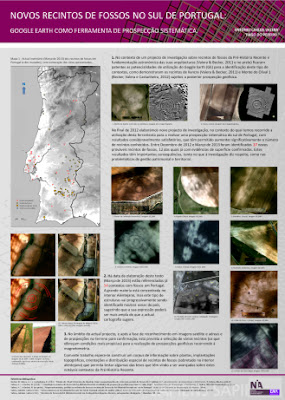
0221 - Poster on ditched enclosures found in Google Earth

Presented to the I Congress of the Portuguese Association of Archaeologists...


See here

Sunday, November 17, 2013

0220 – Juromenha 1 ditched enclosure

Location: Alandroal municipality, Évora district, Alentejo, South Portugal)
Chronology: Late Neolithic
Bibliographic references: (Calado e Roque, 2013)

The ditched enclosure of Juromenha 1 was detected and surveyed in the context of the Alqueva dam mitigation process, in the early XXI century. The survey revealed a plan that suggests a wavy sinuous ditch, with a linear one running parallel. 


Plan of Juromenha 1 (after Calado e Roque, 2013)

The sinuous ditch has a “v” profile, with 2 meters wide and 1,8 meters deep. Four radiocarbon dates put this ditch between 3400-2900 BC.


Ditch section (after Calado e Roque, 2013)


If wavy ditches became more frequent in the 3rd millennium BC in Alentejo, Juromenha 1 clearly shows (as Águas Frias and Ponte da Azambuja also do) that this design emerged in a Neolithic context, where we must search for the reasons that will allow us to explain and interpret these layouts. And not in the chalcolithic walled bastions, as once was supposed.

Friday, November 15, 2013

0219 – Dating ditched enclosures

The number of ditched keeps increasing in Portugal (namely in the South). Having a good chronology of these sites is crucial for the understanding of their emergence, development and fall. I have registered know almost sixty in Portugal, but just 1/6 has been dated by radiocarbon.


Chronology of ditched enclosures of Recent Prehistory in Portuguese territory.

Next week, in the first Congress of the Portuguese Association of Archaeologists I will be presenting a paper that does the synthesis of the available radiocarbon dating information for these enclosures and, based on that, it will be underlined the main tendencies that can be perceived in these architectures during the Neolithic and Chalcolithic.


 Since the proceedings will be released during the congress, the paper will be available by the end of next week. 

Monday, November 11, 2013

0218 - Timber circles (?)

More timber circles at Alentejo? Or just circles made of pairs of pits? Or just coincidences?


Saturday, November 2, 2013

0217 – Almadan #18


The journal Almadan has just been published. Public presentation was today.

Inside there is a paper of mine making a synthesis (a discourse for specialists but also for general public) of the “state of the art” regarding prehistoric ditched enclosures in Portugal: a historical review of the research and dynamics of discovery, an evaluation of interpretative discourses, a censure of some situations regarding preservation and some notes on the potential for public display. 


Wednesday, October 30, 2013

0216 - Communicating interpretations

I come back to Santa Vitoria virtual reconstitution.


I definitely do not agree with it. There is no evidence of a bank inside the ditch. If there was a bank, some pits would have been covered by it; the inside area would have been highly restreated and, most important, there would have been evidences of erosion inside the ditch from a bank built with the geological material. Instead, we have inside the ditch layers of structured depositions and occupation features.

But my point here is that the impact on public opinion of words and pictures is not the same. I want to argue that drawing a scene is more powerful than just describe it by words. Our society is, more than ever, dependent on visual senses. It is easier to memorize an image than a written discourse.

That should give a higher sense of responsibility to the visual reconstitutions of archaeological sites, and in this particular context, of ditched enclosures. What might be presented as hypothesis in discourse seems to be a certain fact when presented in a drawing or animation.

In time, written things became more valued than spoken ones. Today images seem to have a lead. And where discourse might face a doubt, image tends to receive uncritical adherence.  

I don’t know if the readers of this blog agree with this, but I think that we should have this in mind when we decide to use visual representations of our ideas for these prehistoric sites (or any other sites).

Monday, October 28, 2013

0215 – Contenda and Santa Vitória

The recently discovered ditched enclosure of Monte da Contenda (Valera and Pereiro, 2013) through Google Earth, just 4,5 km from Santa Vitória ditched enclosure, raises some interesting questions, just like other enclosures that have been recently identified closer to each other (I remember the case of Salvada and Monte das Cabeceiras 2).

Monte da Contenda has at least three ditches, probably of patterned sinuous design, just like Santa Vitoria. It is in a slope facing south. And behind that horizon is Santa Vitoria.

Monte da Contenda, facing its southern horizon.

Naturally, the same circumstance can be perceived from Santa Vitória: Monte da Contenda is just behind that northern horizon.

Santa Vitória facing its northern horizon

The proximity between these two ditched enclosures, although with no direct inter visibility, needs to be explained. They seem to be contemporaneous (at least in part).

This is a new problem to deal with in Alentejo: the spatial proximity of so many ditched enclosures that seem to be generally contemporaneous (a problem long addressed in European contexts). If they are not, well, than we have to deal with short leaving sites. Which raises other problems to the traditional discourse (and again, not a problem unknown in Europe).

We are arranging things to do geophysics at Monte da Conteda. We hope to get new data to address these problems in a more solid way.

References:

Valera, A.C. and Pereiro, T. (2013), “Novos recintos de fossos no sul de Portugal: o Google Earth como ferramenta de prospecção sistemática”, Actas dos I Congresso da Associação dos Arqueólogos Portgueses, p.345-350.

Wednesday, October 23, 2013

0214 - Two different overlapping enclosures at Moreiros 2?

This is what the geophysics interpretation might suggest. 


General interpretation of Moreiros 2 geophysics (magnetogram from Helmut Becker)


A first one (A) presents mainly palisade structures and has a more irregular design, following the layout of topography.

A second set of enclosures (B), partially overlapping the first, is characterized mainly by ditches, with patterned features (namely gates) and with different designs, more concentric and that don´t respect the topographical layout.


The two possible sets of enclosures.

The two inner ditches of this second sequence (the only ones archaeologically excavated, have been dated from Late Neolithic. That means that the first sequence of enclosures is earlier, maybe from a middle Neolithic. To be true, that would take back a little the emergence of enclosure in Alentejo (as it happens in central Portugal with Senhora da Alegria enclosures).

It would also be interesting to date the outside ditches of the second sequence, the ones that have a sort of polygonal design, for the only parallel we have for that layout is in Chalcolithic walled enclosures (S. Pedro, Porto das Carretas).

This data and ideas were published in:

António Carlos Valera, Helmut Becker e Rui Boaventura
MOREIROS 2 (ARRONCHES, PORTALEGRE): GEOFÍSICA E CRONOLOGIA DOS RECINTOS INTERIORES, Apontamentos de Arqueologia e Património, 9.

 Download HERE.

Tuesday, October 22, 2013

0213 - New number of AAP journal


 Volume 9 of the journal Apontamentos de Arqueologia e Património has been published. In this volume there are seven papers related to four Portuguese ditched enclosures: Perdigões, Porto Torrão, Outeiro Alto 2 and Moreiros 2. Free download here.

Here are the references:

António Carlos Valera
CRONOLOGIA ABSOLUTA DOS FOSSOS 1 E 2 DO PORTO TORRÃO E O PROBLEMA DA DATAÇÃO DE ESTRUTURAS NEGATIVAS “TIPO FOSSO”

Randi Danielson e Patrícia Marques Mendes
POLLEN ANALYSIS OF LATE NEOLITHIC DITCH DEPOSITS FROM THE PERDIGÕES ARCHAEOLOGICAL SITE

António Carlos Valera, Victor Filipe e Nelson Cabaço
O RECINTO DE FOSSO DE OUTEIRO ALTO 2 (BRINCHES, SERPA)

António Carlos Valera, Helmut Becker e Rui Boaventura
MOREIROS 2 (ARRONCHES, PORTALEGRE): GEOFÍSICA E CRONOLOGIA DOS RECINTOS INTERIORES.

Lucy Shaw Evangelista e Ana Maria Silva
TOMB 3 - PERDIGÕES PREHISTORIC ENCLOSURE (REGUENGOS DE MONSARAZ, PORTUGAL): FIRST ANTHROPOLOGICAL RESULTS.

Lara Milesi, José Luis Caro y Juan Fernández
HALLAZGOS SINGULARES EN EL CONTEXTO DE LA PUERTA 1 DEL COMPLEJO ARQUEOLÓGICO DE PERDIGÕES, PORTUGAL

J. E. Márquez-Romero, José Suárez Padilla, Elena Mata Vivar, Víctor Jiménez-Jáimez, J. L. Caro Herrero y Pablo Cuevas Albadalejo
ACTUACIONES ARQUEOLÓGICAS REALIZADAS POR LA UNIVERSIDAD DE MÁLAGA EN EL YACIMIENTO DE PERDIGÕES (REGUENGOS DE MONSARAZ, PORTUGUAL). TRIENIO 2011-2013

Friday, October 18, 2013

0212 – A wood henge at Outeiro Alto

A concentration of pits in a very small area was excavated at Outeiro Alto 2. The concentration was generically circular (Figure 1). 

Figure 1

The pits were all almost empty of archaeological material. In the periphery there were three Late Neolithic hypogea and a grave pit (Figure 2).

Figure 2

To try to understand the concentration of pits in this small area, with no overlaps and surrounded by tombs, a study of the morphology and volumes of the pits was done. It was possible to cluster the pits in three groups of sizes and deepness (Figure 3).

Figure 3

When those clusters were plotted in the plan, a pattern emerged (Figure 4): the deepest pits formed a circle with a square in the centre and two pits towards north; then surrounded by the smallest pits; and the intermediate pits scattered in the SW area. 

Figure 4

The distribution, the size of the central pits and the absence of archaeological material inside them (just two or three small shards of pottery) clearly suggest a circular wooden structure of henge type surrounded by the tombs.


This context is published here: Valera & Filipe,2012

Wednesday, October 16, 2013

0211 - Wood constructions

 I have been suggesting that we have several evidences of wood constructions in portuguese prehistory that could be similar to some wood henges or palisades of Europe. One of those evidences is the area C of Outeiro Alto 2 (Valera e Filipe, 2012 pdf). I will talk here about that in the next post.

Today I present the strange case under excavation (by Omniknos/Era): 145 pits, with no archaeological material inside, very close to each other, but with no overlaps, producing several aligned rows. They are clearly for large posts (trunks) and do not define a circle, but an elongated area, partially curved. In the outside curved row an interruption is visible and might correspond to a passage.


This is a very strange context. If it is prehistoric (there are several prehistoric contexts nearby), it reinforces the idea that many pits are post holes and that we have to have notion of their spatial distribution to detect the kind of structures they belong to (as it happened at Outeiro Alto 2).


Detail of the outside curved row of pits

Monday, October 14, 2013

0210 – Causewayed enclosures in Portugal?

Causewayed enclosures are a typical site from British islands prehistory. However, a recent publication shows the presence of what we should call causewayed enclosures in Iberia, in Northern Meseta (García García, 2013).

Image taken from García García, 2013.

Well, at Herdade do Estácio (Beja), a site being excavated by Omniknos Company (direction of Tiago do Pereiro) a sequence of elongated pits were recorded and they clearly remind the same general plan of a causewayed feature. The materials collected inside the pits indicate a Late Neolithic chronology. The layout and the chronology reminds the enclosure of Fareleira 3, although the ditches are bigger there.


Late Neolithic causewayed feature (?) at Herdade do Estácio. 

This empirical data is scarce at the moment, but starts to suggest that, once again, we might have in Iberia elements that clearly integrate the peninsula in phenomena of European scale.


References:
García García, M. (2013), “Las Pozas (Casaseca de las Chanas, Zamora): dos nuevos recintos de fosos calcolíticos en el Valle del Duero”, Trabajos de Prehistoria, 70:1, p.175-184.

Saturday, October 12, 2013

0209 – Updating Coelheira 2/3

The sections are almost excavated. The ditches sizes and fillings suggest they are palisade ditches. But the interesting thing is that it is not one enclosure with two ditches, as previously suspected, but two enclosures side by side, just a few meters distant from each other.


Enclosure A.


Enclosure B. The two sections excavated. In the right one we can see an interruption corresponding to a gate, as usually facing east.

Thursday, October 3, 2013

0208 – The Santa Sofia Chalcolithic ditch

Prehistoric sites with ditches are still rare in Portuguese Estremadura. So far we had notice of a small ditch in Mafra municipality (Gonçalvinhos), with an uncertain chronology. Recently a new site with a ditch was published (Pimenta et al, 2013): it is the site of Santa Sofia, in Vila Franca de Xira.

Under a complex occupation of the Late Bronze Age (and following historical periods) a ditch section was discovered and dated by radiocarbon and archaeological material from the Chalcolithic.

Although the characterization of this context is still limited, its discovery is of extreme importance because it documents the presence of these kind of structure in the Estremadura Chalcolithic where, so far, only walled enclosures were known. We will be waiting for the detailed publication of this new ditch context.


Ditch plan under later hut structures and ditch section (image taken from Pimenta et al, 2013)

References:

Pimenta, J., Soares, A.M. e Mendes, H. (2013), "Cronologia absoluta para o povoado Pré-Romano de Santa Sofia (Vila Franca de Xira)", Cira_Arqueologia, II, p.181-194.

Friday, September 27, 2013

0207 – Ditches and palynology

Ditches are very interesting contexts for pollen analyses in Alentejo (a dry area, and therefore not very good for pollen preservation). Ditches can perverse humidity, helping the preservation of pollen.

In Perdigões, after a first study done by Jane Wheeler (Wheeler, 2010)  we applied for these analyses through the Portuguese Laboratory of Archaeosciences (LARC) that initiated a new program of scientific cooperation with the National Archaeological community in 2012. For that a specific project was elaborated: “Reconstitution of paleo-environments in Perdigões area.”

The collected samples in the excavations of 2012 were already processed and the results are in press in the journal Apontamentos de Arqueologia e Património that will be published next October 2013, being authors Randi Danielsen and Patrícia Marques Mendes.

Sampling in ditch 6

They refer to the Neolithic contexts of Perdigões and provide a quite relevant information about the landscape flora of the period in the surroundings of the site.


Diagram of results from Randi and Mendes, in press. 


In 2013 we continue to developed the project and new sampling was made, now integrating Chalcoltic contexts. We hope to get a good picture of the evolution of local landscape during the late fourth and 3rd millennium BC and provide empirical data that help in the interpretations of the human occupations and activities in this region.

2013 sampling in the Late Neolithic hypogeum structure

Bibliographic References:

Daneilsen, R. and Mendes, P.M. (in press), “Pollen analysis of Late Neolithic ditch deposits from the Perdigões archaeological site”, Apontamentos de Arqueologia e Património, ), Lisboa, NIA.ERA, p.13-20.


Wheeler, Jane (2010), "Paleoenvironmental assessment of two archaeological sediments from Perdigões, Alentejo region, Portugal", Apontamentos de Arqueologia e Património, 6, Lisboa, NIA-ERA Arqueologia, p.41-45.

Wednesday, September 25, 2013

0206 – Debating ditch fillings and ditch excavations.

Interpretation of ditch functions depends a great deal on what we find inside them. And what we find inside them depends a great deal on the way we excavate them.

Ditch 8 of Perdigões is a good example of these two circumstances.

First let’s look to what we find inside the ditch. The top of the ditch filling was exposed in a 12m area. It showed a deposit covered by a central concentration of fragments of pottery. Removed that first layer of pottery another one appeared. Just like ditch 12, Late Neolithic ditch 8 had its top filling layers incorporating an “avenue” of pottery shards (Figure 1).


Deposition of pottery shards in the top of ditch 8 of Perdigões (taken from the report of 2013 excavations)

But the section that we have done in the ditch showed that this horizontal depositions of pottery, stones and faunal remains continue in depth. If we look to the plans of this section (figure 2) we will see that there are layers of depositions of those material intermediating with layers of just earth, until the bottom part of the ditch, where this kind of depositions became continuous.

Plans of the stratigraphy f the section excavated in ditch 8 (taken from 2013 report)


So, ditch 8 was filled with layers of intentional horizontal depositions of selected materials (fragments of pottery, faunal remains and stones), in an intermittent rhythm. This stratigraphy is not coherent with draining or defensive functions. It clearly shows that there was an intentional filling that went on in an intermittent rhythm, providing horizontal layers. The intermittence suggest that these practices of intentional deposition were intermittent themselves. That they were periodical.

The sections of a 1,5m deep ditch and the definition of the top layers of pottery depositions took us two campaigns (one month each) to achieve.

The second issue that I want to address is: why this kind of depositions are not occurring in other ditch enclosures excavated in Portugal? Are they a particularity of Perdigões? Perhaps they are. But one thing I am convinced: the actual practices of excavations in rescue archaeology would not be able to detect these depositions. When you have to excavate a ditch and get paid 55€ a square meter (independently of the depth), then you have to be satisfied if a rough image of the stratigraphy is obtained. Archaeology of negative structures is progressively becoming the activity of quickly emptying pits and ditches.

So what empirical record will we have to deal with in our debates, theoretical hypothesis and social-historical problems? What is being rescued? Does it worth what it costs?  

The problematic of ditch enclosures is not just about understanding Prehistoric communities. Is also about understanding our own society, and why we do what we do.

Tuesday, September 24, 2013

0205 - Ditched enclosures and carved rocks

It is an interesting relation, although difficult to establish, that seems to be emerging in some sites.

In Moreiros 2, several rocks with cup marks were identified the periphery of the enclosures.


Carved rocks with cup marks in the periphery of Moreiros 2 enclosure (images taken from Valera, Becker and Boaventura, (in press) "Moreiros 2 (Arronches, Portalegre). Geophysics and chronology of the internal enclosures"


At Torrão a rock also with cup marks is known near the enclosure and in Perdigões there is a rock inside the Chalcolithic enclosure, but outside of the Neolithic ones almost totally carved with cup marks, also present at one of the stones of the cromlech.

Carved rock with cup marks at Perdigões.


Of course we do not know the exact chronology of the cup marks, but in these three situations they are in the periphery of Late Neolithic ditched enclosures. What they mean we do not know. We can only speculate and many ideas were put forward. But maybe there is a relation between them and the practices that were taking place inside the enclosures.  

Thursday, September 19, 2013

0204 – Something different (but...)

Today’s post is not about Neolithc or Chalcolithic enclosures, but about another kind of enclosure and from a different chronology. It is about an Iron Age funerary ditched enclosure that is being excavated by Omniknos Company (direction of Tiago do Pereiro) near Beja.

This is a rectangular enclosure defined by a ditch about 1 meter wide, with a central rectangular grave inside. What is interesting is that the ditch shows several recuts. In one of them a human skeleton was recorded. It is possible that there are more, for the majority of the ditch is still to be excavated.


The larger rectangular enclosure with the central grave (the grave in the ditch is being excavated)

In one side, the rectangular ditch is partially overlapped by another ditch that seems to be part of another rectangular enclosure, but not totally finished and with some intervals in the sides, as if the rectangular enclosure was built in an additive way. It also has a central rectangular grave and a human skull just started to appear in the corresponding ditch. It seems that there is a central grave surrounded by graves in the enclosing rectangular ditches.


The other enclosure overlapping the large one.

Some similar contexts from Iron Age were excavated in Alentejo in the recent past: Vinha das Caliças (by Arqueohoje Company) and Poço das Gontinhas (by Era Arqueologia Company).

Of course we are in presence of a different cultural and historical context, but it did remind me of Bela Vista 5, a ditched enclosure from late 3rd millennium with a grave surrounded by two ditches, being the outside ditch built by segments and showing recuts (although no human remains were found in the small excavated areas).

In fact, these funerary monuments seem to present a sequence of use and construction until they get their final shape. A bit like the Bronze Age cist graveyards that grow from a previous central grave. And the same process of “construction in use” before reaching the final form was also documented for megalithic monuments in Galiza.

We tend to focus in what we see and tend to forget that we see final stages. Things have often quite complex biographies and that later look might result of a process of “construction in use” or “by use”, and not done at once. But they present a pattern. Which means that there are prescriptions and intentions that are followed, resulting in the final significant designs. We see that in several prehistorical ditched enclosures


Although from different times and cultures, there are human behaviors that respond to similar social needs or involve similar social problems. 

Monday, September 16, 2013

0203 - Pé da Erra ditched enclosure

Ditch section of Pé da Erra, showing a clear recut.

An old site has revealed itself as a ditched enclosure in recent excavation of the UNIARCH team. It is Pé da Erra, near Coruche, known since the seventies of the last century. We still do not have specific information about the new findings. But the simple fact that there is a ditch enclosure is significant, because this is a peripheral area to the actual concentration of ditched enclosure in Alentejo’s hinterland. It is a confirmation of what I argued some time ago, that this kind of contexts would start to appear in other areas of the country (in this case in the Sorraia valley, a tributary of the Tagus river), even if they don´t show the same concentration of sites. Things appear when the times are ready for them.

Information and picture taken from here

Friday, September 13, 2013

0202 - New enclosures under excavation (2)

The internal enclosure of the new site near Santa Vitória (Beja). Photo from Rui Ramos.


Thursday, September 12, 2013

0201 – New enclosures under excavation (1)


A new ditched enclosure is being excavated in Alentejo, near Santa Vitória (Beja), by the company Omniknos, directed by Rui Ramos..

At least four sections of ditches will be cut by a water pipeline, possibly corresponding to three different structures. They are being defined and one of them is clearly sinuous, adding another site to the already long list of Portuguese ditched enclosures with sinuous ditches.

By the material associated, they must be from the 3rd millennium BC, but one of the ditches is cut by a Bronze Age cist. Believing the locals, a necropolis of cists in this area has been destroyed over time by farmers.


To Southeast, maybe 300/400 meters there is a funerary Chalcolithic hypogeum, where three pits are connected by internal passages. Between the hypogeum and the enclosures there are some pits, some of them from Bronze Age.


This is a quite interesting new site.

Sunday, September 8, 2013

0200 - Papers on ditched enclosures


In the next six months several papers of mine (some in collaboration) regarding Portuguese ditched enclosures, at present in press or being finished, will be published. Here are the references:

A. Valera (2013), “Breve apontamento sobre a dimensão cosmogónica dos recintos de fossos da Pré-História Recente no Interior Alentejano”, Cadernos do Endovélico, Nº1.

A. Valera (2013), “Recintos de fossos da Pré-História Recente em Portugal: investigação, discursos, salvaguarda e divulgação”. Almadan. 18.

A. Valera (2013), “Cronologia dos recintos de fossos da Pré--História Recente em território português”, Actas do 1º Congressos da Associação dos Arqueólogos Portugueses.

A. Valera, (2013) “Cronologia absoluta dos fossos 1 e 2 do Porto Torrão e o problema da datação de estruturas negativas “tipo fosso”. Apontamentos de Arqueologia e Património. 9.

A. Valera, H. Becker, R. Boaventura (2013), Moreiros 2 (Arronches, Portalegre): geofísica e cronologia dos recintos interiores. Apontamentos de Arqueologia e Património, 9.

A. Valera; T. do Pereiro (2013) “Novos recintos de fossos no sul de Portugal: o Google Earth como ferramenta de prospecção sistemática.”, Actas do 1º Congressos da Associação dos Arqueólogos Portugueses

A. Valera, V. Filipe, N. Cabaço (2013). “O recinto de fosso do Outeiro Alto 2 (Brinches, Serpa). Apontamentos de Arqueologia e Património. 9.

A. Valera; A.M. Silva; J.E. Márquez Romero (2014) “The temporality of Perdigões enclosures: absolute chronology of structures and social practices”, SPAL.

Friday, August 30, 2013

0199 – Perdigões ditch 8.

The section in ditch 8 of Perdigões was completed this year. It has a “V” shape profile, with around 1,6 meters deep. It was filled with a sequence of deposits, alternating layers of horizontal distributions of fragments of pottery, stones and faunal remains with layers of earth with less archaeological materials. No evidences of erosion inside the ditch of any possible associated bank. No evidences of any associated wooden palisade.


Here is an image of the section profile (the Northeast one) with the holes of sampling for luminescence and pollen analysis.


Tuesday, August 27, 2013

0198 – The complexity of enclosing

Around here Prehistoric enclosing is sometimes considered an easy issue. Maybe because it is approached as a Prehistoric matter of obvious and literal meaning. However, not just prehistoric issues aren't easy and obvious, but also enclosing is a complex sociological attitude.

Enclosing is a decision that can respond to many different social and psychological reasons. Therefore, Sociology and Social Psychology cam help archaeology (if archaeologists let them).

A good example of this is the work of Tim Insoll (professor of the University of Manchester), that has been studying shrine contexts in Africa. I attend to one of his talks in Oxford and it became clear to me that there is a lot of matter in this kind of work that can be useful for the research of Prehistoric enclosures (maybe that is why he was invited to talk in a meeting dedicated to Prehistoric enclosures).

The shrine is a sort of memorial, monument or grave structure that encloses something, being to protect or conceal what is inside or to protect what is outside (from what is inside). In his studies in Africa, Insoll deal with a lot of different forms of enclosing: material ones, symbolic ones; evident or just suggested; completely involving the object or space, or just demark it. Sometimes those shines were made to protect what was inside, sometimes it was precisely the opposite.
 
 
An example of a modern shrine: the statue of the Portuguese physician Sousa Martins that lived in the second half of the XIX century (located in Campo dos Mártires da Pátria, Lisbon). By his work he was venerated by his patients and it became a legend and a saint for the public, that until the present pray for his intervention in times of need of medical assistance. The statue is now a shrine, involved by hundreds of plaques that thank his “miracles”. The plaques involve him, protect and generate a internal space of holiness.

Those examples tell us that we need to have a solid theoretical background about the phenomena of enclosing to approach enclosures, since the issue is not an easy one. Enclosing is a sociological and psychological problem. It is an attempt to control and conform, not the world, but the world as it is expressed by some ideas. They are built to prevent, to protect, to differentiate, to separate, to hierarchize, to impose pathways, to impose visibilities, to represent ideologies, to spatially materialize social and political structures, to communicate.  The reasons for enclosing may be quite diversified and may respond to several different motivations.

There is a lot to learn in the social and psychological phenomena of shrining that can be helpful to researches that deal with prehistoric enclosures.
 
 
Detail of the shrine of plaques in Sousa Martins statue.