Thursday, June 14, 2012

0098 - Dating ditch fillings


Dates from ditches 3 and 4 from Perdigões. They are Chalcolithic ditches, dated from the 2nd quarter and middle 3th millennium BC. But in a top layer of ditch 4 we got a Late Neolithic date (a ditch that has to middle 3rd millennium dates for bottom deposits). A typical situation of incorporation of earlier material. In fact, just 3 meters away there was a Late Neolithic pit burial that was disturbed in Chalcolithic times. Taken from Valera & Silva, 2011.


Dating the fillings of ditches and interpret the results is a tricky issue.

First, we must be aware that we never date the opening of a ditch, only the beginning of its filling. And we do not know the time between the opening and the beginning of the last filling process of the ditch (I say last because we must considerer the possibilities of re-openings).

Second, what is integrated in the ditch filling may be older than the filling process or even older than the excavation of the ditch. In fact, especially in sites with long living periods (like Perdigões, for instance), where earlier materials can be about or the excavation activity is so intense that earlier deposits are constantly being remobilized, it is natural that some of the material that integrates a filling deposit inside a ditch is actually from earlier occupations. By dating this material we will not date what we intent to. We will be dating earlier material that has nothing to do with the time the ditch building or its filling moments. That is why sometimes we have earlier dates in top deposits and later ones in the bottom deposits.

So, how can we avoid these problems?

Dating ditch fillings implies dating series of samples, where outliers can be detected. It is not just the need of dating the sequence of deposits to determine the filling rhythm (which is, of course, important). Even if there are just one or two deposits, we must have more than just one date, precisely because of the problems raised by the typical dynamics and activities that take place in this kind of sites.

It is more expensive, I know. But one date in a ditch, except if you have a well defined and closed context (like a burial, for instance), is far from enough. And every date or series of dates need a serious critique, regarding the dating procedures, dated material, relation to context, nature of the context formation, post depositional events, and so on. Or we will just adding smoke to an already foggy area.

Bibliographic References:
Valera, A. C. & Silva, A. M. (2011), “Datações de radiocarbono para os Perdigões (1): contextos com restos humanos nos Sectores I e Q”, Apontamentos de Arqueologia e Património, 7, Lisboa, NIA-ERA, p.7-14.

Monday, June 11, 2012

0097 - How did they do it?


They did choose adequate bedrocks. There is a clear relation between Portuguese ditched enclosures and geology that enables an easier excavation. But making it easier doesn’t mean it was easy.

In fact, to excavate the ditches, that in South Portugal started at least in Late Neolithic (second half of the 4th millennium), they must have used the technology developed since earlier times: the technology developed in mining for flint or for minerals, like variscite.

I have already drawn the attention for the fact that there are several evidences of “transference of technology” in Prehistory, from some areas to others; from some kind of architectures to others. For instance, the building of the access corridor between walls to the inside enclosure of Castro de Santiago is clearly an application of megalithic building procedures.

So, to study the technologies adopted to open ditches it is in mining tools and in mining techniques that we might find a window. There is a clear interesting relation that can be established between the researches of these two Neolithic practices.

And the same can be argued about the hypogeal building tradition. There is knowledge and an assemblage of techniques and tools that must have had a transversal use in different building activities. Underground techniques of excavation are certainly earlier than ditched enclosures in western Iberia. They might have provided the means to the architectural materialization of some new ideas. Just like the megalithic “engineering” was certainly helpful for walled enclosures.

So, looking into mines, and mining material, might be useful when we study ditched enclosures.

Wednesday, June 6, 2012

0096 - The sunset of ditched enclosures?


Small inside enclosure with a burial pit.


When did the Neolithic and Chalcolithic type of ditched enclosures stop being built? Well, as the question suggests, it would have been at the end of the Chalcolithic, of course. In fact, at the present moment, no ditched enclosures like those are known to have been built in the second millennium BC. I recently have used this apparent situation to argue that the Neolithic and Chalcolithic ditched enclosures were related to a specific ideology (or cosmogony) and that they stopped being built in the beginning of the second millennium precisely because that cosmogony was structurally changing at the end of the third millennia (Valera, in press).

Well, the enclosure in excavation by ERA at the moment seams to reveal a relative late chronology, although every elements of the architecture also seems to be rooted in the Neolithic tradition. It is soon to be conclusive. But the pottery from the ditches suggests a late chronology in the third millennium and there are pits with pottery that clearly indicate the first half of the second millennium (Bronze Age).

The image, at the moment, is that the enclosures were built in a late Chalcolithic and that pits were still being excavated in the early Bronze Age. But the relations are still to be established. In fact, the inside ditch, the one that slides deeper from the gate to de back, is very small (just 8 m diameter inside) and has only one pit inside. Well that pit has an individual burial with three complete undecorated vessels and a Palmela point, indicating a moment of transition to Bronze Age. Is it a latter pit? Or this small enclosure was built to enclose that pit?


Detail of the burial excavation in a earlier stage. We can see the leg and the skull (and a stone over the neck).

It is soon to decide. But what this data is suggesting is that some of this Neolithic rooted architecture and practices might have reached the beginning of Bronze Age. In a way not yet recorded.

That does not question yet the idea that those architectures are essentially related to a Neolithic cosmogony. Structural transitions are just like that, presenting punctual and exceptional late extensions. So let’s see what the absolute chronology says.

One thing is already certain: this site is important to the problematics regarding Portuguese ditched enclosures.     

Refrences:
Valera, A.C (in press) “Mind the gap: Neolithic and Chalcolithic enclosures of South Portugal” (A. Gibson & J. Leary, eds), ENCLOSING THE NEOLITHIC: RECENT STUDIES IN BRITAIN AND EUROPE, BAR.

Thursday, May 31, 2012

0095 – Modular architectures

This is an interesting perspective into ditched enclosures building procedures: the possibility that a ditch is not done in a row, but is a result of several modules, parts, that are added. The enclosure is a result of a process. The result is a sequence of overlapped (or almost overlapped) sections of short ditches, frequently with different dimensions.

I argue about this possibility recently, in two papers (Valera & Becker, 2011; Valera, in press). My first contact with the idea was in a paper on Herhxeim enclosures (a Neolithic LBK site), where human bones were scattered inside overlapping sections of ditches that, at the end, defined an enclosure. Then I read a short sentence in a blog from Manuel Calado and the excavations he did in Salgada (Borba, Alentejo), where he spoke of a similar situation (only with no human bones). I even did a post on that issue (see here).
Then I recall the thesis of Pedro Diaz del Rio (2008) about the building process of some walled enclosures: the possibility that walls in sites such as Los Millares or Castanheiro do Vento might have been built in modules; as independent, but converging, projects develop through time as a metaphor of a trans equalitarian social organization, still far from coercive and well stratified social relations.   

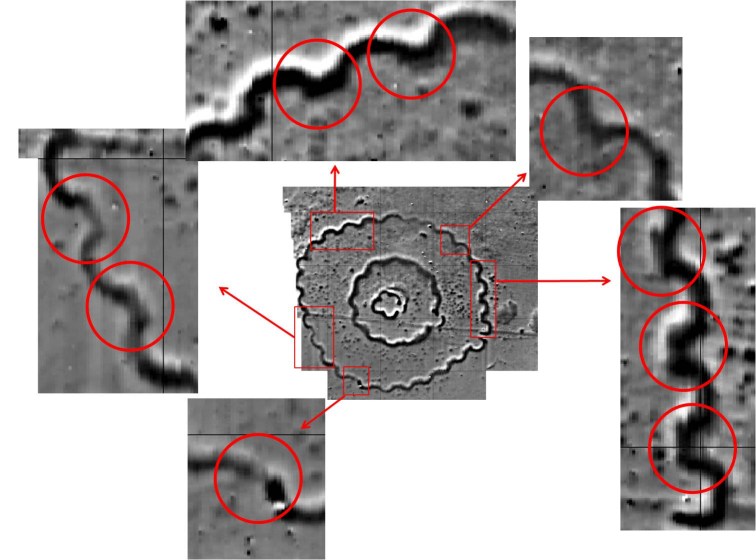
When the geophysical image of Xancra came out of the magical machine of Helmut Becker, it became clear to me that we might be in presence of a similar situation of a ditch built through the adding of modules. This is quite clear in the outside ditch of Xancra, as I point it out in the paper (Valera & Becker, 2011).


The highlights show areas where parts of the ditch seam to “join” or “overlap”.

Well, the enclosure under excavation by Era in Alentejo is confirming this situation. In the external ditch we are documenting sections, with different depths and widths, that are overlapping showing, with no doubt,  that the final enclosure is the result of a sequence of additions of ditch sections with different dimensions and made in different moments in time. The building of this outside enclosure was a long process. It was not made at once. And, naturally, it was not for defence or drainage.


Here is a gate. In both sides there is a section of the ditch that is not very deep. Then, in both sides, two new sections were made, more deep and  large, cutting the previous sections. It is clear the semi circular joining of the different sections.


Here is another overlap: the left part of the ditched, already filled, was excavated in a slide way and the new section filled with a different sequence of depositions.


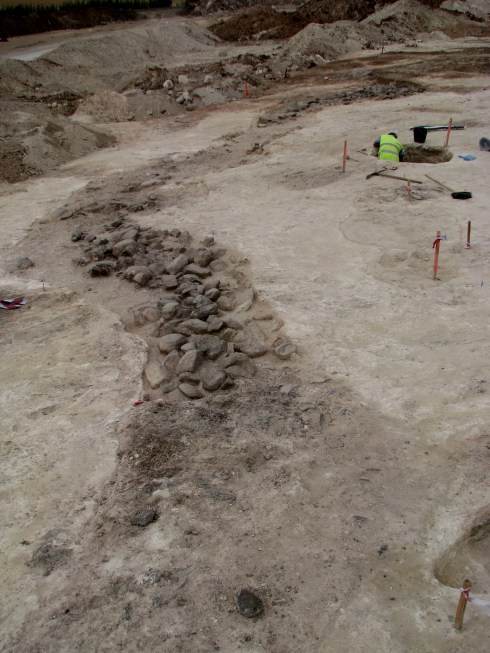
Here we can see the top of the sinuous path of the outside ditch. It is quite clear that there is a part with top stones, then a section almost without stones, and then again a new section with stones (that ends at the cut present in the previous image). Even at the top filling this sectioning of the ditch is visible.

I wonder when the traditional discourse, that sees fortified settlements in all these sites, will get in time with the actual empirical evidence.  

Ah! Yes, I almost forgot: there are funerary contexts inside.

Bibliographic References:
DIÁZ-DEL-RIO, Pedro (2008), “El context social de las agregaciones de población durante el Calcolítico Peninsular”, ERA Arqueologia, 8, Lisboa, Era-Arqueologia / Colibri, p.128-137.
VALERA, António Carlos (in press), “Fossos sinuosos na Pré-História Recente do Sul de Portugal: ensaio de análise crítica”, Actas do V Encontro de Arqueologia do SW Peninsular.
VALERA, António Carlos & BECKER, Helmut (2011), “Cosmologia e recintos de fossos da Pré-História Recente: resultados da prospecção geofísica em Xancra (Cuba, Beja)”, Apontamentos de Arqueologia e Património, 7, Lisboa, NIA-ERA, p.23-32.

Wednesday, May 23, 2012

0094 – The irregularity of ditches.


The inner ditch of the enclosure in excavation process: 1,5m deep in first plan survey (back of the dich); 1,3m deep in the next one; 0,8 at the gate. Notice the presence of a layer of geological material at middle depth.

The irregularity of ditches, not in plan, but in depth, is another issue that is very important to question functionality and meaning.

It is expectable that a ditch to accomplish the function of defence or infrastructure of a palisade presents a general regularity in terms of depth. The problem is that for almost all Portuguese ditched enclosures only small parts of ditches were surveyed. But recently to exceptions to this “rule” allow treating this problem.

At Senhora da Alegria, a small enclosure (about 10 meters diameter) at the top of the site presented a circular plan with one gate and only a pit inside. The pit had inside large fragments of burned wood and the ditch revealed a interesting depth profile: it grows deeper from the back towards the gate, with a significant slide percentage.

At the enclosure in process of excavation in Alentejo the inside ditch presents a similar size and also just one gate. But the depth of the ditch reveals the opposite behaviour: it grows deeper from the gate sides to the back: 0.8 / 0.4 at both sides of the gate and 1,5 at the back of the circle. So it presents also a significant slide. Inside, also just one pit, still in excavation (sealed with stones and with complete pots underneath).

What the strange behaviour of the depth of these ditches suggests is that they cannot be associated to any kind of palisade or regular barrier: were they built to be walked inside, from the surface to a deeper area? It has something to do with water circulation and accumulation in a specific area of the ditch? I recall that at least one of the ditches of the enclosure of Águas Frias the structure also ended in a sort of ramp. Let us see what this new enclosure has to reveal in the next days. For the moment the fillings of the ditches are as heterogeneous as their depths.


The back of the ditch: note the absence of geological material layer just one meter away from the other profile.

Thursday, May 17, 2012

0093 – The number keeps growing

Pit in front of one gate in the external ditch

The number of ditched enclosures keeps on growing in Portugal, as to be expected if we take into account what has been changing in Portuguese Recent Prehistory in the last few years. A new double ditched enclosure, dated from Chalcolithic, is under excavation in South Portugal.
It is a promising site to question and answer some of the issues “on the table” about this kind of sites.

Monday, May 14, 2012

0092 - Sinuous ditches at Perdigões


This is the geophysical image (by Helmut Becker) of a part of the double wavy ditches (3 and 4) of Perdigões and the surveyed area of Sector I (with the two ditches excavated areas and some excavated pits). The ditches are just 2,5 meters apart, but the inner one is slightly latter than the outside one (radiocarbon dating shows this). They decided to open a new ditch, just two and a half meters inside the previous one that was only half filled with horizontal deposits of stones, shards of pottery, faunal remains and some human bones. It would be easier to re-excavate the previous ditch. But they didn’t. It seems that they decided to open a new one, wavy, parallel and very near to the one already existing in that area (to be filled in a similar way). Once more, the traditional functional and economical logic fails here.

Sunday, April 29, 2012

0091 – Maps and their meaning


Everything means something; usually more than just one thing. Archaeological maps are no different.
The first map presents a distribution of enclosures in Europe. That map has been published several times by several authors for a long period of time. In that map Iberia is almost a desert and that has at least two readings.
Both are expressed by the second map. Iberia has also a lot of enclosures, not just walled, but also ditched. This is a result of recent work that is demonstrating that Iberia is participating of the structural trends of Recent Prehistoric Europe (I wonder why is there some surprise). But what these maps also show is the low level of internationalization of Portuguese archaeology. If there isn’t a significant effort of European researchers to get acquaintance whit Portuguese archaeology (and language doesn’t explain it all), it is also true that Portuguese archaeology has lower levels of internationalization (and language is still not an excuse). New data is available for some time now and it is not reflect in recent international publications.
So what do those maps really express? The desert on Portugal ravels, in a way, the recent nature of the developments of Portuguese Archaeology (the recent discovery of several ditched and walled enclosures) but also reflects its traditional poor conditions for international relationships and circulation of information.    
So those distribution maps need a careful hermeneutic approach. As usually happens whit any kind of statement.  

Tuesday, April 10, 2012

0089 – Timber


Parts of the magnetograms obtained by Helmut Becker for Perdigões and Moreiros 2, showing alignments of post holes from possible palisades and (in the case of Moreiros) of a timber circular structure.

This is a material that has been underestimated in the Iberian archaeology of Prehistoric architecture. The reason is certainly related to the poor preservation of timber evidences, but also to axiomatic postures. We are too much preset to stone building and to forget wood.

The recent projects on the geophysics of ditched enclosures (at Perdigões by Málaga University and NIA-ERA, and in several others sites by NIA-ERA in a project directed by me, all having Helmut Becker as geophysicist) has suggested other ways: wood must have been much more important in building positive structures. There is even a possible wood circle in Serpa area (in print), that might bring to Iberia a type of Neolithic constructions not yet documented.

But the main problem is that Portuguese archaeologists (or should I say Iberian archaeologists) are not trained to recognize the remains of wooden constructions. I mean post holes.

Ho yes, we have a lot of small post holes, of 10, 15 centimetres diameter. Those we have and the huts imagined with them. But large timber structures are missing, though geophysics shows it differently.

In fact, there are many pits in many places traditionally and axiomatically interpreted as “silos”, or reused “silos”, that don’t have (or almost don’t have) anything inside but sediments and some stones. But many of those pits might be large post holes, of trunk posts, like the ones shown in Helmut’s geophysical images. The problem is that the majority of archaeological interventions are spatially restricted, and what might be a sequence of post holes becomes one or one and a half “silos”.

Architectures with large timber trunks must start to be considered in Iberia. There is now enough evidence to suggest that those constructions might have had a significant importance, far more than recognize by traditional discourse.

But, naturally, with this recognition new problems arise. If we are talking of post that are tree trunks we must start asking what kind of trees we have here that might provide long strait trunks for those constructions. South Iberia, even then, was not central Europe or North Europe. Vegetation was different. So, what kind of tree could be use for large timber structures using tree trunks? A question that was not asked yet to the people that studies paleo flora.

A new inquiry is in the agenda.

Monday, April 2, 2012

0088 - Fraga da Pena and beakers


Fraga da Pena is the site where the largest number of beaker pots was recorded in central-north Portugal. But the most interesting thing is the distribution of beaker shards inside the two walled enclosures: concentration of shards from several half pots in the middle of the outside enclosure; the distribution of beaker shards along the path that leads to the inside enclosure and a deposition of a complete exemplar of the few International style beakers at the end of a stone alignment in the sequence of the gate.

The general appearance of Fraga da Pena, without evidences of inside domestic structures or contexts, already suggested a particular symbolic social role for the site and for the activities that were developed there. But the spatial distribution of the beaker remains inside reinforces that discourse.

Here we have large walls (more that 3 meters wide) that enclose very small areas where no domestic remains were detected. On the contrary, exceptional material is present and dominates the archaeological assemblages. The monumental natural tor and the relations to local landscape complete the image of a special place for special practices. Beaker pottery seems to have played also an important role in those practices.

(Image taken from Valera, 2007)

Thursday, March 22, 2012

0086 - Perdigões "in tour"


After Bradford and Oxford in March, Perdigões will be “touring” in April through some Portuguese universities. Conferences about the site, its global research program and other similar portuguese enclosures will be held at University of Algarve (12th), Porto (18th) and Coimbra (26th). Information about times and places will be displayed soon.

Monday, March 12, 2012

0085 - Why are they circular?


"It is not the right angle that attracts me neither the strait line, hard, inflexible, created by man. What attracts me is the free and sensual curved line, the curve that I found in the mountains of my country, in the sinuous path of its rivers, in the waves of the sea, in a woman’s body. From curves is made the Universe – the infinite curved universe of Einstein."(Oscar Niemeyer – my translation)

"Não é o ângulo recto que me atrai nem a linha recta, dura, inflexível, criada pelo homem. O que me atrai é a curva livre e sensual, a curva que encontro nas montanhas do meu país, no curso sinuoso dos seus rios, nas ondas do mar, no corpo da mulher amada. De curvas é feito todo o universo – o universo curvo de Einstein."
(Oscar Niemeyer)

That is why I think we cannot understand these sites without an approach from the history of mentalities and cosmogonies. Because architecture materializes mind and world views.

Sunday, March 4, 2012

0084 – Funerary practices in walled enclosures: the case of Leceia.


Structure with human remains at Leceia (after Cardoso, 1994:fig.40)

At the walled enclosure of Leceia, near Lisbon, some human remains were recorded inside a circular structures built with vertical slabs and rows of stones, reminding tholoi architectures.
This structure was interpreted as a garbage dump structure. Here is what the excavator said about this context (my translation):

“In Leceia we may have documented one of these conflict situations, occurred already in Middle Chalcolithic; in one structure of garbage accumulation (...) several uncompleted and scattered human remains (especially teeth) were collected mixed with domestic rubbish; the anthropological study indicated the presence of three adult individuals, males when it was possible established gender. Such results, together with the deposit conditions, related to unburied individuals, gives substance to the hypothesis that those are the remains of attackers that, after being slaughtered, didn’t deserve a grave like the ones from the settlement” (Cardoso, 1994:106).

This statement was produce before other human remains were known in other walled enclosures and, especially, before the striking evidences of funerary practices in ditched enclosures such as Perdigões and Porto Torrão.

Today this statement is questionable. Not just because of the uncritical use of the concept of garbage applied to Prehistory and for most of the so called garbage structures (Hill, 2000), but mainly because the evidences are showing that death management is much more complex during the 3rd millennium BC than we previously suspected and that the “megalithic solution” and primary depositions are just a restricted part of the rituals involved.

According to the recent evidence, characterized by a diversity of funerary practices inside enclosures that show a significant variety of body treatment and post mortem manipulations that can be addressed to ritual practices, this context needs to be reinterpreted in the light of wider empirical evidence and different theoretical backgrounds.

Hill, James D. (2000), "Can we recognise a different european past? A constrastive archaeology of Later Prehistoric Settlements in Southern England", (J. Thomas ed.) Interprettive Archaeology. A reader., London, Leicester University Press, p.431-444.

Thursday, March 1, 2012

0083 - Cutting and re-cutting

Some ditches present evidences of re-cutting. When a previous and larger ditch is totally or partially filled, sometimes another smaller ditch is dug in those deposits. Usually, this is not a total reopening of the first ditch, but simple of a small part. That is the case recently detected at Senhora da Alegria, in a ditch belonging to the Late Neolithic phase.

This means that we cannot look at this reopening as a “maintenance task”, but rather as a new use (even if with similar purposes) of a previous perceived structure. And the argument of saving efforts, by excavating deposits rather than bedrock, is not always an argument. At Senhora da Alegria all ditches are excavated in deposits, being of previous occupations or of weathered sandstones. So, no big difference can be assumed in terms of work invested. So why are there, in the more than a dozen ditches already identified, situations like new ditches using part of previous similar structures?; situations that new ditches are open quite near to others without reopening them?; situations where a new smaller ditch is totally dug inside another?

The answers can be different for all situations and probably related to several dimensions of a living site: changes in space organization; changes in the occupied area; consequences of a seasonal occupation, etc. But what I want to argue is that the reopening of a previous ditch that is filled with stones and archaeological material is not just an economic strategy of those communities or an activity that brings troubles to the archaeologists (because changes and mixes older materials with recent ones): it is an intervention that is strongly conditioned by the earlier structure, in physical terms, but also in meaningful ones. It is a moment when a given community interacts with previous construction and previous materials. What would they think when they dug previous artefacts? Would they just have a “catchment attitude”? Or were those materials seen as a link to ancestors? How would a segment point or an early arrowhead be seen by a person that produces more recent bifacial and all retouched arrowheads? Or a decorated shard in a moment where all pottery was undecorated?

Digging a ditch in previous structures is different from digging a ditch in the bedrock. That is certain, but not only because of the labour involved or because of a similar space organization. It has consequences in other dimensions that are important to understand past decisions and their outcomes.

Wednesday, February 29, 2012

0082 - Alegria’s early contexts

At Senhora da Alegria the excavation in course steel reveals new structures from several Prehistoric periods, now apparently reaching the Late Chalcolithic or even Bronze Age (we already have a Late Bronze Age deposition of two vessels). But in a specific area, early Neolithic contexts keep appearing.

At the bottom of the stratigraphic sequence, a layer with scattered stones, fireplaces, pottery and microlithic materials revealed (in the top) an alignment of post holes (possibly from another orthogonal structure). Decorated pottery is present, including this “cardial” decorated shard.


This level is cut by a small ditch that has a structured gate facing East. This ditch is, in terms of the stratigraphic sequence, from the same phase of the sub rectangular house detected earlier.


These two moments correspond to the earliest occupations of the site that can be addressed generally to the early and transition to the middle Neolithic. But the occupation is incredibly long (even if not continuous).

Monday, February 20, 2012

0081 - Neolithic ditches and the dynamics of growth


Perdigões inside ditched has just been dated by C14, as well as some related structures (such as a small ditch of a possible palisade and a latter occupation of a hypogeum type pit).
A lower layer inside de ditch (Ditch 6) was dated from 3330-3020, the small ditch from 3340-3020 and the top of the hypogeum pit from 3090-2910 (dates calibrated and at two sigma interval – still not published). Material culture is generally the same inside these structures and is perfectly consistent with what we know about the period.

The inside enclosure of Perdigões is, therefore, contemporaneous of other Late Neolithic ditched enclosures, such as Juromenha 1(four dates between 3370-2920 – Mataloto & Boaventura, 2009) or Ficalho (with a date from 3500-3020 – Soares, 1996) or others not yet dated sites.

But one interesting question emerge from this situation: why deed Perdigões enclosures kept growing with the built of new and larger enclosures during the third millennium, reaching a 500m diameter and presenting huge negative structures, and why the other Neolithic enclosures didn´t.

My answer has to do with the symbolic role that Perdigões assumed since the beginning. A role that is not so clear in other Neolithic sites. In fact, some enclosures seem to express architectonically (their design, topographical location and landscape connections) and in terms of the ritualized practices that were present inside (namely the funerary practices) a status that may be responsible for the historical role they played and the dimensions they achieved. They are basically expressing Neolithic world views and their gigantic size (by the time standards) at the end of the 3rd millennium may very well be interpreted as the singing of the swan of Neolithic Cosmologies.

Just like in other historical dynamics, the growth of some highly symbolic and socially meaningful sites may be what conditioned the development of others. The answers for this kind of questions must be searched at a regional scale and not at a site one.

Bibliographic references:
Mataloto, R. & Boaventura, R. (2009), “Entre vivos e mortos nos IV e III milénios a.n.e. do Sul de Portugal: um balanço relativo do povoamento com base em datações pelo radiocarbono”, Revista Portuguesa de Arqueologia, nº12, 2, Lisboa, p.31-77.
Soares, A. Monge (1996), "Datação absoluta da estrutura neolítica junto à Igreja Velha de S. Jorge (Vila Verde de Ficalho, Serpa)", Vipasca, 5, Aljustrel, p.51-58.

Thursday, February 16, 2012

0080 - Perdigões and funerary practices

The meeting is taking place tomorrow at the University of Coimbra. See here.

Monday, February 13, 2012

0079 - International Meeting

“Recent Prehistory Enclosures and Funerary Practices”

Fundação Calouste Gulbenkian, Lisbon
6 to 8 of November 2012.

The questions raised by ditched and walled enclosures have been frequently at the heart of several debates regarding Peninsular Recent Prehistory communities.

Amongst the numerous issues discussed, one has emerged with particular relevance: the direct relation between enclosures and funerary practices. These relations, in some cases, go as far as to question the very notion of necropolis as a separated space for the dead and present similar situations that have been address with different approaches, generating different answers.

Because the last years have provided, in Iberia, important information regarding these contexts and their connection with funerary practices, and because Perdigões enclosure became an anchor project in this matter, the ERA Arqueologia decided to promote an international meeting to debate this issue.

Being a European phenomenon, we understand that the approach to the peninsular data must be framed and confronted with the information available to other European regions, aiming to encourage debate at different scales and from different contexts, experiences and theoretical backgrounds. Therefore, the meeting will assemble a group of researchers with provenance in several European countries where this topic has particularly importance.

Programme and Registration File here

Friday, February 10, 2012

0078 - Ditches and palisades


This association is frequently assumed for ditched enclosures, but is rarely demonstrated. In what concerns Portuguese enclosures, we have some short notice on a possible inside palisade in Juromenha Neolithic ditched enclosure and we have the images of the inner enclosure of Perdigões (see here) and of some of the lines of Moreiros (see here) that suggest the existence of palisades. But, for the majority of sites already excavated or prospected by geophysical methods, that evidence is missing and the available data does not allow generalised positive statements about the association of palisades to ditches (and even less of earth banks).
Nevertheless, some sites do suggest that association. One of those sites is Senhora da Alegria, where a larger ditch seems to be associated to a smaller one that runs in parallel, and could be an infrastructure to support a palisade. This is not clear yet, for sometimes the smaller ditch seems to slightly overcome the bigger one, but that could be related to readjustments in time and the hypothesis remains.
Those structures are from a Late Neolithic and generally contemporaneous of the others ditched enclosures that also suggest, as referred above, the presence of palisades. But the Chalcolithic ones do not present the same evidence. Has this association a chronological significance? A question to have in mind.

Friday, February 3, 2012

0077 – “Idols” from Perdigões


This will be a topic for a conference in the next ERA annual meeting that will take place in Lisbon in March 10th.

Perdigões present a great variety of artefacts that are usually interpreted as “Idols” (an issue to be discussed), made in different external raw materials (like ivory, limestone or schist). It is interesting to notice that are very few made in ceramic when compared with other raw materials, which seems to suggest a strong relation between raw material and object meaning and value.
Another interesting aspect is that, if almost all the “idols” appear in funerary contexts, some are present inside ditches and certain types appear (so far) in specific funerary contexts, even when they are contemporaneous with other burial structures.
These issues and others will be presented and debated at the meeting.

Thursday, February 2, 2012

0076 - Animal figurines at Perdigões


A paper is in press about the ivory animal figurines at Perdigões enclosure. These are very small sculptures of several animals (ox, deer, birds, rabbit and a possible pig) that have between 1 and 2 cm.

If one of them might be attached to a larger artefact, the others seem to be independent objects.
Why are they so small?
Why, in a period of schematic art, are they so realistic?

They resemble the small animal figurines of Dorset culture (Arctic hunters and gatherers) and its animistic context of function and meaning described by Tim Ingold. Could a similar line of inquiry share some light over the Perdigões ones?

I do believe animistic thought and its world views are an indispensable approach to understand much of the problems that we are confronted with at Perdigões set of enclosures.

Thursday, January 26, 2012

0075 – Processes of ditch filling


Dog skull inside ditch 3 of Perdigões.

The nature and the processes of ditch fillings are central to ditched enclosures interpretation. Several elements can be analysed to try to understand those processes. One of them is fauna.

Usually, faunal remains are approached in terms of levels of articulated bones, present and missing bones, structure of the deposition of the bones, animals represented and other associated elements.

Recently, a study of faunal remains from ditches 3 and 4 of Perdigões enclosure done by Cláudia Costa (“Problem of filling the ditches 3 and 4 (Sector I) of Perdigões (Reguengos de Monsaraz”, Estudos do Quaternário, 6, APEQ, Porto, 2099/2010) based on stratigraphic analysis of faunal remains”) showed that the taphonomical approach is also quite relevant and that, together with the analysis of other present elements, can be a precious help to interpret the formation process of the fillings.

Here is what she says in the papers abstract:

“During archaeological intervention on sector I of Perdigões ditch enclosure (Southern Portugal), dated from the IIIrd mil¬lennium B C, a section of Ditch 3 and 4 were excavated. The ditches are parallel “V” shaped structures, excavated on local bed rock, of 1,70 m (Ditch 3) to 2 m (Ditch 4) deep.

The ditches were filled with a sequence of anthropic sediments with archaeological artefacts, mostly potsherds, and vertebrate fauna. The species present in both ditches are suids, the most numerous, followed by bovids (domestic, and an element of an auroch), ovi¬caprids, red deer, horse, dog/wolf, rabbit and hare. The anatomical representation is the opposite in each ditch: in Ditch 3 the most common elements are from cranial and appendicular skeleton, whereas Ditch 4 is filled mostly with elements from axial skeleton. This aspect linked with the specific spatial association of bones and other elements, as pottery or pebbles, with an unequivocal intentional organization, doesn’t seems to fit on the pattern of secondary refuse. The faunal remains seem to integrate the “intentional depositions” at least on some points of the sequence.

On both structures, faunal assemblages are more fragmented on top of the sequence, and on the base, faunal remains tend to be more complete. The transition of more fragmented to less fragmented bones is materialized by intentional depositions layers, unit 58 on Ditch 3 and unit 34 on Ditch 4. On the other hand, in some stratigraphic units, root etching was identified on bone surfaces. Root etching is linked to vegetation that settles on soil profiles top, on the early stages of pedogenic developments. The existence of this phenomena point to a discontinuous filling process of the two ditches, where stratigraphic units remain stable and exposed long enough to pedo¬genetic process begin. On Ditch 3, the assemblage from unit 58, interpreted as “structured depositions”, is one of the most affected assemblages by root etching, which means that after sedimentary formation and installation of “depositional structures”, the unit was exposed. The same unit was affected as well by a natural water channel that mutilates the unit’s surface.
The other natural taphonomical signatures are manganese oxide, which affects continuously all remains from Ditch 3, and in a low percentage Ditch 4, and carbonate calcium that particularly affects the base assemblages in both ditches. This aspect reveals the strati¬graphic stability of the sequence.”

Sunday, January 22, 2012

0074 – What’s inside?


Possible reconstitution of the wall of the inside enclosure of Castro de Santiago and of one of the inside huts.

Usually, inside ditched enclosure we only have negative structures, basically constituted by pits. Positive structures are rare or simply nonexistent.

On the contrary, pits are rare in walled enclosures (see here), but positive structures are common (whit some exceptions, such Fraga da Pena). But it is current to find walls or alignments of stones that are usually interpreted as hut infrastructures or stone pavements.

At Castro de Santiago (Beira Alta), inside the inner enclosure, two of those huts were identified where the bedrock makes a sort of basin, and they had central fireplaces built in a hemi hexagonal plan with three slabs.


Hut infrastructures at Castro de Santiago and actual parallel in Africa.


Hut infrastructures at Castro de Santiago.

Although the walled architecture and the use of rock tor formations is similar in Fraga da Pena (just 8 km north in the same valley), the excavations made there didn’t reveal any similar structures inside. Being alike, those two walled enclosures seem to have played different functional roles, although, in terms of social identity management, they might have had similar tasks (as I have argued elsewhere: Valera, 2007).

It is important to notice what’s inside an enclosure and what’s missing to start to give them names. Structures, material cultural, social practices evidences, etc. He must “built” contexts first. So, when we have a surface evidence of a stone wall or a geophysical image of ditches, we must be careful in interpretation. If the general plan of the architecture of an enclosure could give us enough information to develop some analysis and propose some interpretation and develop some ideas, the cases of Castro de Santiago and Fraga da Pena remember us that similar general architectures could enclosure quite different contexts.

Friday, January 20, 2012

0073 – Map of Portuguese Prehistoric Enclosures


This is a map in permanent updating. From now on, it will be available in a separated page, next to the bibliography ones at the top of the blog.
It is, of course, of free use. Citation of the blog is the only request.

Tuesday, January 17, 2012

0072 - Águas Frias ditched enclosure

Location: Alandroal municipality, Évora district, Alentejo, South Portugal)
Chronology: Late Neolithic
Bibliographic references: Calado & Rocha, 2007.


Plan of Águas Frias (after Clado & Rocha, 2007)

Águas Frias is an interesting enclosure excavated during the rescue program of Alqueva dam, but still to be fully published. Is located in the valley of the Lucefecit river, a tributary of the Guadiana.

It presents in the left bank of the river three apparently concentric ditched enclosures, designed by wavy ditches with “V” profiles, being the middle one more regular in plan than the others and presenting the outside one a complex sequence of negative elongated structures in the north part. Based on its archaeological material the site was dated from Late Neolithic (second half of the 4th millennium BC).

Because the archaeological intervention was done when the dam was already flooding, the Lucefecit was then much larger and it was impossible to know if the ditches go through the river to the other side and the enclosures would be crossed by the water stream, as it happen in other cases (Porto Torrão, in Portugal; Pijotilla in Spain).

Nevertheless, the site was interpreted as a village and the ditches as defensive structures associated to palisades which ended in the water borders, creating an image of a semi circular settlement.


Águas Frias model(after Calado, 2007, in http://megasettlements.blogspot.com/2007/01/re-creating-past_24.html).

An interesting aspect, yet to be explained, is the way in which one of the ditches ends, presenting the extremity in a ramp filled with a stone pavement.


Image of the ditch end (after Calado & Rocha, 2007)

Wednesday, January 11, 2012

0071 - Enclosures mental images


Some Portuguese enclosures present designs that have patterns that are visually striking from above and as a whole (from an aerial picture or geophysics image, for instance). Just like, with the natural differences, the Nasca “land drawings”. But their builders and users didn´t saw those images (well, there is the question of the possible balloons in Nasca).

But, didn´t they?

Could sites like Xancra, Santa Vitória, Outeiro Alto 2, Monte do Olival or Perdigões not have a previous and spread mental image that the architecture was reproducing? In fact, we have the metal capacity of imagining and visually conceive what we actually cannot see. We built mental maps, for instance, and we can build mental plans, even without flying or drawing.

So, how really were perceived these enclosures in terms of their plans and designs? Could this perception of Xancra ever been formed in the mind of one of its builders or visitors?

Tuesday, January 10, 2012

0070 - Neolithic ditches and rectangular houses

Senhora da Alegria is a surprising and important site, by the combination of its location, structures and chronologies.

It is located in central Portugal, where the littoral platform gives way to the central mountains and in one of the pathways to the hinterland of Beira Alta central Portugal, where no ditched/palisade enclosures were known until now.

A sequence of occupations dating from Early Neolithic (with “cardial” decorated pottery) to Late Neolithic is being excavated by the Omniknos company (scientific coordination of António Valera and field direction of Tiago do Pereiro and Rui Ramos) in a context of archaeological emergency intervention.

The site presents several ditches, some of them probably corresponding to palisades, that form more than one enclosure, with several moments of construction with structures cutting other structures.


One of the ditches of the eastern side of the site.

Those ditches cut previous early Neolithic layers and some of them may be also from the same period and others from a middle Neolithic phase. These ditches are then covered by layers with positive stone structures, dating from middle/late Neolithic.


One of the ditches of the western side of the site, going under Late Neolithic layers.

It is, therefore, the earliest site with this kind of structures known in Portugal (and in this area of Portugal), revealing that also in western Iberia this architectures are present at the early stages of the Neolithic (as was already documented in eastern Iberia).

But it also present one (at the moment) rectangular house. Rectangular Neolithic houses are quite rare in Western Europe. In Portugal, for the recently excavated and published site of Castelo Belinho in Algarve (by Mário Varela Gomes), post holes were argued to be evidences of the presence of rectangular houses. Nevertheless, some scepticism has been revealed by some scholars relating those interpretations, because of the large and scattered number of post holes. But at the present site the image of the structure is striking and leaves no doubts: a sub-rectangular house (with slightly rounded corners), with central posts aligned with the entrance (facing east), with 10,5 x 5,5 meters.


Image of the house post holes.


One of the post holes of the entrance (left) and one of the central ones, reaveling two construction moments (right) .

So, this archaeological context also presents for the first time in Iberia the “association” of rectangular houses with ditches at a same site and gives strength to the interpretations developed for the Algarve’s site.


Located at in a hinterland transitional point, this site is already fundamental to the research of Neolithic process of West Iberia, to the emerging of the surrounding megalithism (and the Beira Alta one) and to the problems concerning the appearance of ditches/palisades enclosure architectures in the peninsula.

Not everything is bad news in this new year of 2012.

Friday, January 6, 2012

0069 - Topographical differences


I’m now writing the paper presented at the Rome conference, where the main issue was to compare ditched and walled enclosures in South Portugal, since they share the same general space and time.

I centred my analyses in eight aspects: tendency for architectonic separation; topographical location; dimensions; design ; architectonic dynamics and associated practices, cosmological foundation of architecture; relation to funerary practices; practice of metallurgy. Some of these items were already discussed here (dimension, presence of pits).

Today I would like to draw the attention to the topographical differences between the locations of this to kind of architectures. Those differences can be expressed as a more homogeneous location strategy for walled enclosures that prefers exclusively hill tops (or cliff edges or high rocky tors in central and north Portugal), and a more diversified location for ditched enclosures. We can find them also on hill tops (Santa Vitória, Outeiro Alto 2), but they can be in the middle of smooth slops (Xancra, Monte do Olival), in natural amphitheatres (Perdigões, Paraiso), in large valleys (Porto Torrão) or spread from small and flat hill tops, through the slops and to the lower ground (Moreiros 2).

In fact, ditched enclosures do not reveal a particular standard pattern of location. By the contrary, they relate themselves with the landscape in diverse ways, although we can observe some tendencies, like the interest of building facing east (frequently with gates astronomically orientated).

This difference between ditched and walled enclosures is just one amongst others, suggesting that, in general, they didn’t serve exactly the same purposes or, at least, that those architectures were responding and were related to specific practices that were not shared by both.

Monday, January 2, 2012

0068 - Plurality of funerary practices in ditched enclosures


Cremation experiment in progress (Tõnno Jonuks & Marge Konsa, “The revival of Prehistoric burial practices: three archaeological experiments”, 2007)

This is an issue that will be discussed in the becoming meeting on Perdigões research project, next February. There, new radiocarbon dates demonstrate that several different practices regarding bodies manipulations were occurring at the same time (according the method resolution capability) in several areas of the enclosure and in different structures.

The data that is being obtained at Perdigões, as I have said already elsewhere, demands new theoretical approaches to funerary practices in Late Neolithic / Chalcolithic, namely the ones that deal with the problems of the unity and ontology of the body and that develop relational conceptions of burial places and structures. The notion of necropolis, as a clear individualized space for the dead, is clearly at risk in Perdigões, as in other large ditched enclosures.

Tuesday, December 27, 2011

0067 - Ditches are spreading to Central/North Portugal


Plan of Gonçalvinhos (Mafra, Lisbon) small ditch segment (after Sousa, A.C., 2010, O PENEDO DO LEXIM E A SEQUÊNCIA DO NEOLÍTICO FINAL E CALCOLÍTICO DA PENINSULA DE LISBOA, PhD thesis presented to FLUL.)

If the last decade and a half revealed a concentration of ditched enclosures and ditched structures in South Portugal hinterland (and I believe that some negative structures sectioned by Edia tube lines are yet to be correctly evaluated, probably enlarging the numbers and the “troubles”), the recent years are indicating that those archaeological realities are also present in central and north Portugal, in different topographical contexts. Some of those sites, in present process of excavation, may even be the earliest known in west Iberia with ditches.

Ditches are now emerging in Lisbon peninsula (as the one in the image), in the Mondego basin (just at the “gate” of the Beira Alta hinterland), in the deep hinterland of Beira Interior (East of the central mountains system) or near the coast, in Aveiro or Maia (north of Oporto). The north half of Portugal is revealing what should be expected, if we attend to the general picture (European and Iberian): that, like megalithism (to which they seem to be well connected), ditches structures and ditched enclosures are present and that specific research programmes should be design to detect them (since local topography and land use makes them more difficult to detect than in the southern plains).

I suspect that the near future will bring some surprises about the building of enclosures in the central coast of Portugal and their importance to the so called process of “becoming Neolithic”.

Thursday, December 15, 2011

0066 - Funerary practices in Perdigões


(Click the image)

A meeting for presenting results and debate perspectives of a ongoing project of research on funerary practices at Perdigões ditched enclosure will take place in February 2012.