Showing posts with label aa_Walled enclosures. Show all posts

Saturday, February 15, 2025

0451 - Abordagem comparada / Comparative approach


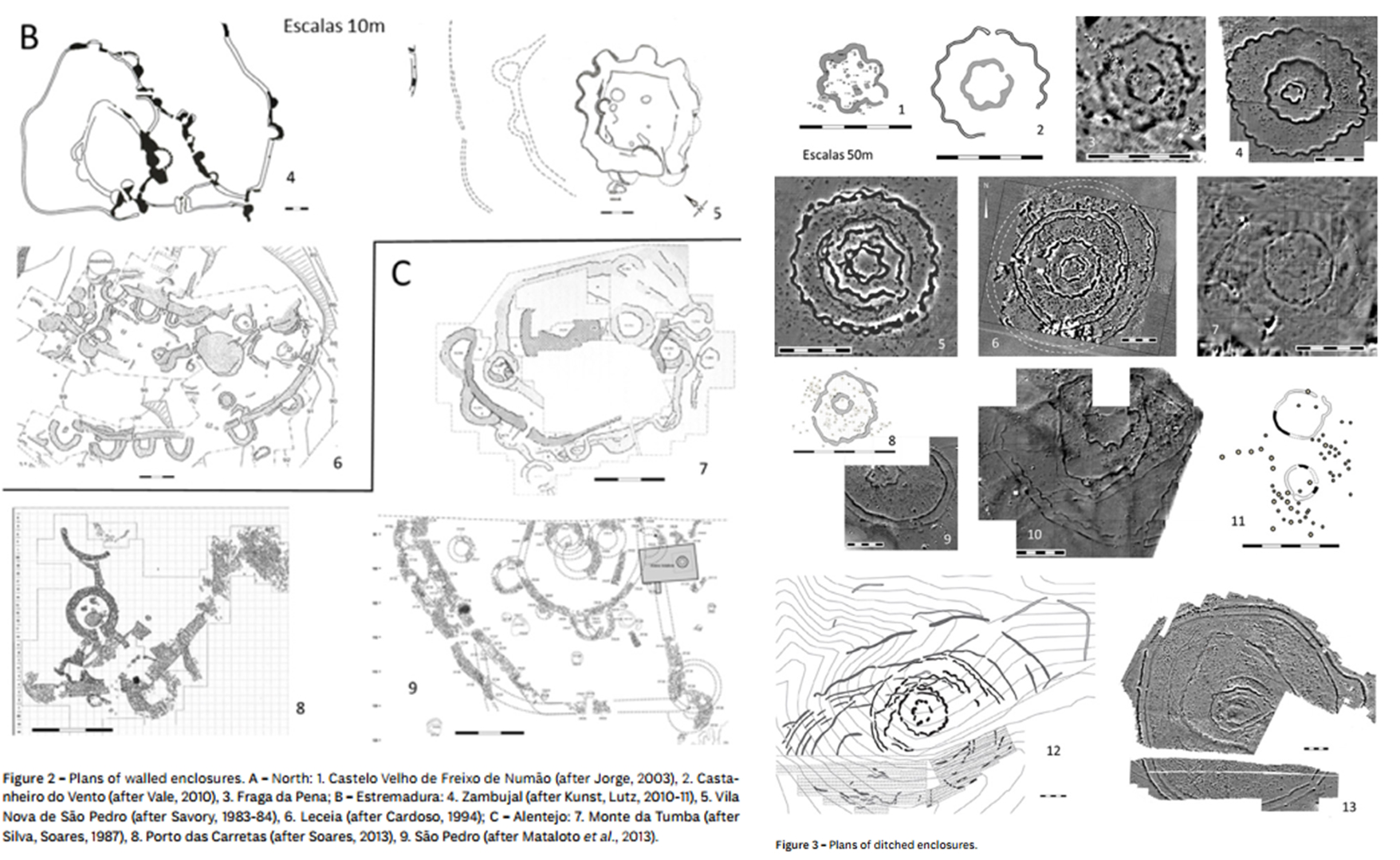
Após dois anos de ausência, volto aqui com renovada vontade. Retomo com o último texto que publiquei sobre o assunto: “Recintos de Fossos e Murados da Pré-História Recente no sul de Portugal: uma breve abordagem comparativa.” No resumo sublinha-se a intenção central do texto: “Este ensaio desenvolve uma abordagem comparativa destes dois tipos de sítios no Sul de Portugal, discutindo as suas diferenças e proximidades a vários níveis, não num quadro dominado pelas dicotomias de doméstico / cerimonial ou funcional / sagrado, mas focado em como estes contextos permitiam de forma diferente ou semelhante a materialização de algumas das práticas sociais, económicas e ideológicas das sociedades Neolíticas e Calcolíticas.” O artigo pode ser obtido aqui:

https://www.academia.edu/126226405/Ditched_and_walled_enclosures_of_Late_Prehistory_in_South_Portugal_a_brief_comparative_approach

After two years of absence, I come back with renewed will. I return with my last paper on the issue: “Ditched and Walled enclosures of Late Prehistory in South Portugal: a brief comparative approach”. I the abstract the main goal is underlined: “This essay develops a comparative approach to these two types of sites in South Portugal, discussing their differences and proximities at several levels, not in a framework submitted to dichotomies such as domestic/ ceremonial or functional/sacred, but focused on how they differently or similarly allowed and materialized some of the social, economic, and ideological practices of Neolithic and Chalcolithic societies.” The paper can be downloaded here:

https://www.academia.edu/126226405/Ditched_and_walled_enclosures_of_Late_Prehistory_in_South_Portugal_a_brief_comparative_approach

Saturday, May 23, 2020

0437 - Fraga da Pena: a cerimonial place.

Fraga da Pena. A small enclosure built against a granitic tor, in order to condition the access to a passage (truly megalithic) to the other side of the fraga, where one reaches an authentic altar over the deep valley and with a wide view over the landscape. And it constitutes a stage for those who are higher up the slope. A scenario that inspires sacredness and is conducive to ceremonial practices, which the archeological contexts involved also suggest.


Monday, December 16, 2019

0429 - Publication on intentional fragmentation and depositions

This book brings the conferences presented in Lisbon 2017 about fragmentation and depositions in Pre and Proto Historic Portugal. It has some information and debate about the presence of human remains inside the ditches of Perdigões and depositions in other contexts of ditched and walled enclosures.

To be download here.


Tuesday, November 5, 2019

0425 - Portuguese enclosures in meeting

A meeting to commemorate the classification of Perdigões enclosure as National Monument will be held at Carmo Museum in Lisbon next November 23. Here is the program.


Friday, June 2, 2017

0371 - Workshop on Prehistoric deposition and fragmentation practices

Depositions and fragmentation, as intentional and meaningful social practices, are common in many European prehistoric enclosures. The same happens in Iberian ones, although not always perceived, conceptualized, and questioned as so.

To encourage the debate and research of such subjects in Portuguese archaeology the following workshop was organized and will take place in Lisbon, in 14 October. We have chosen a small auditorium of a public book store to do this. We also want to encourage the public interest.


Friday, September 30, 2016

0354 - Meeting Enclosing Worlds


In 12 days will start the international meeting Enclosing Worlds, that will take place in Reguengos de Monsaraz, Évora, Portugal. The program can be seen here: http://enclosingworlds.blogspot.pt/p/program.html (registration to assist in the same site).

For the first time in Portugal we are putting in confrontation historical trajectories from different continents where enclosure building had relevant social roles. It is an exercise of compared Archaeology to discuss social processes and enlarge horizons in the approach to this complex and fascinating expression of the humane: architecture as space organizer, as expression of cosmologies and as social synthesis.


An organization of Era Arqueologia S.A., ICArEHB centre and Municipality of Reguengos de Monsaraz (with the support of Esporão, FCT, DRCALEN, Municipality of Redondo) and with the enthusiasm of Perdigões project.

Wednesday, June 1, 2016

0348 - Enclosing Worlds Programme


The programme for oral presentations at the meeting Enclosing Worlds (to be held in Reguengos de Monsaraz, Portugal, 12-14 October 2016) is now available here.

Lower registration fees to attend until 31 July (here).

Monday, May 9, 2016

0344 - Beakers and enclosures

In the next 12 and 13 of May, in a Iberian meeting taking place at the Faculdade de Letras of Lisbon University, I will be talking about beakers and their social roles in two different enclosures: Fraga da Pena in Central/North Portugal and Perdigões in the South. A walled enclosure and a ditched one. 

Some International beakers from Perdigões enclosures

Nailed impressed Beakers from Fraga da Pena walled enclosure.

There are many differences between these two contexts and between their “beaker expressions”. But there are also some similarities: the ways the characteristics of both sites are intrinsically related to the social roles that beakers seem to have been performing there. Two good examples of a contextualism sound bite: that objects and contexts are meaningfully bonded.  Discussing beakers as an entity regardless their contextual specificities is a possible approach at a large scale of analysis, but it would hardly enlighten on the diverse ways they were historically active and regionalized.

Sunday, April 3, 2016

0341 - Brasilian (Proto) Jê enclosures come to Enclosing Worlds


(Image taken from http://jelandscapes.exeter.ac.uk/regions/highlands/campo-belo-do-sul/)

The brasilian Jê enclosures will be present at the meeeting Enclosing Worlds, where the enclosing phenomena will be discussed by confronting different historical situations and trajectories from different parts of the world. You may see the abstracts as they are being progressivelly dislayed at http://enclosingworlds.blogspot.pt/p/abstracts.html.

Friday, March 18, 2016

0337 - Enclosures, Identity and heritage: The Fraga da Pena case.


Fraga da Pena (Fornos de Algodres, Guarda) was discovered for Archaeology by me (and two “Isabels”) in 1991. Between that year and 1998 I excavated the site and produced a scientific discourse about it (part of my PhD thesis). It is now an important context in Portuguese archaeology regarding the bell beaker phenomena and the late 3rd millennium BC, as well as for the debate regarding enclosures in Iberia.

That work gave way to a project of public display that tried to bring the site back to a socially active role (see here what was done). Today, it is used as the main banner of the Municipality page on Facebook (where we can read “A history that touch us”) and its profile is in the logo (left side) of the municipality (curiously with the representation of the sun, something that might have been important in the site’s role in Prehistory (see here).
I am happy. The Fraga is back as a meaningful place and not just for archaeologists. Job done. My thanks to all that have contributed to this, and they were many: from Portugal (obviously the majority), Spain, Czeck Republic, Hungary, Turkey, France, Belgium, USA, Norway, Wales, Poland…

Sunday, February 21, 2016

0331 - Meeting about enclosures and methods

http://arqueocienciasflup.weebly.com/

In the sequence of the research developed about the subject in NIA-ERA, I'll be participating in a workshop at Oporto University (next March 17th) dedicated to debate the relations between the research of enclosures and methodological options and approaches. Here is the program (in Portuguese):

Recintos peninsulares da Pré-História Recente. Métodos multidisciplinares de investigação.

Friday, January 29, 2016

0327 - Abstracts for the meeting Enclosing Worlds

 
The preparation of the meeting Enclosing Worlds is going on. Paper proposals are being received and analysed. Abstracts will be progressively displayed in the web page during the next months.
You may check the abstracts here.

Friday, July 3, 2015

0304 - Enclosing worlds 2016 conference


ENCLOSING WORLDS

Comparative approaches to enclosure phenomena

 12 – 14 OCTOBER, 2016, University of Algarve, Faro, Portugal

 
CONFERENCE PROPOSAL – 1st announcement

 Analogy was always central to archaeological methods and interpretations. It is a powerful tool that has been consecutively criticized and theorized, remaining at the heart of the archaeological practice. Between the large amplitude of the uses of analogy in Archaeology, the cross-culture comparative methods have been shown to be useful to deal with cultural change and the correlations between materiality, human behavior and social organization.

This conference intends to focus on the emergence and development of the European prehistoric enclosures phenomena in the context of a large scale social practice of enclosing expressed by architectures, landscapes and forms of territorial management. It is meant to confront the diversity of the European phenomena between the Neolithic and the Bronze Age with other historical processes of enclosure building developed in other continents and to discuss the social implications and the social roles of such architectures and strategies of space organization.

With this purpose, the conference will reunite case studies from Western and Eastern Europe, Central and Southern Africa and North and South America, stimulating the development of comparative research on this topic and the debate on comparative methodologies, namely regarding the definition of comparable controlled units.

The organization of the meeting will be the responsibility of a partnership between the research group for the Development of Complex Societies of the Interdisciplinary Center for Archaeology and Evolution of Human Behavior (ICArEHB - University of Algarve), the archaeological research department of ERA Arqueologia (NIA-ERA) and the Global Research Program of Perdigões enclosure.

Call for papers is opened until 31 March 2016.
 
Inscriptions for assistance will be open in October 2015.
Contacts: António Carlos Valera (antoniovalera@era-arqueologia.pt)


Tuesday, June 23, 2015

0302 - The possible enclosure of Mercador

Excavated in the beginning of this century, Mercador (Mourão, Évora) revealed a segment of a stone feature that seems to correspond to the base of a wall that would define and enclosure with a diameter estimated in 14m.

Plan of the segment of the stone structure with estimation of diameter (Valera, 2013)
 
 
The site, dated from Chalcolithic, had a posterior occupation during the middle ages that was responsible for the dismounting of some of the previous structures.


Projection of the possible enclosure (Valera, 2013)

The eventual enclosure corresponded to the second phase of the occupation of the site and was located in the extremity of a plane top of a smooth rise, facing the valley of the Guadiana river. Outside two circular stone houses connected by a small wall were recorded. The chronology for this phase is from the second half of the 3rd millennium BC, roughly contemporaneous of the second phase of the Porto das Carretas (just 1,5 km away), where there are similar constructions of stone houses (interpreted as towers by the excavators) associated to bell beaker pottery.


Plan of the stone houses (Valera, 2013).
 
 
Bibliographic References:
 
Valera, A.C. (2013), As comunidades agropastoris na margem esquerda do Guadiana. 2ª metade do IV aos inícios do II milénio AC., Memórias d' Odiana, 2ª Série, 6, Edia.
 

Monday, March 30, 2015

0288 - Visiting Fraga da Pena

A group of german archaeologists and students of Archaeology (headed by Michael Kunst and guided by me) visiting the Fraga da Pena walled enclosure in 2008.


Some took some risks to photograph a painting preserved in one of the rocks of the granitic tor.

Friday, January 16, 2015

0278 - The importance of building.

One of the theories about the social role of enclosures, namely ditched enclosures, is the importance of the building process. Since Evens that the focus on the importance of building itself became a matter of discussion regarding the interpretation of the social role of enclosures. The general idea was that the main social role of the project was performed during the building process, rather than after. Some criticizing of this centered perspective in the building process has been done (for instance Whittle in a recent paper), but the criticism is more about the “centered” than about the “perspective”. In fact, the focus on the building process of enclosures, ditched or walled, is something to be taken into consideration in the understanding of their social role. Let me give you a contemporary example to explain this point.
You are all familiar with the Amish communities in America. And some of you are familiar with their traditions. Some of them have been displayed by the cinema or by television programs. They tend to show the importance of community work. One example is that presented by the Hollywood film (I think is called The Witness) with Harrison Ford. There is a couple that marries and the community joins up to build them a barn. 


When the barn was being build, all the community was there, working together, reinforcing there social bonds and identity, performing their traditions, communicating and perpetuating their world views. It was a social event of structural importance for the community as a whole; after being built, the barn was useful only to the married couple. So, the building process was socially and ideologically meaningful for the community and once the structure was finished it was only economically meaningful for a specific family.  This exemplifies, I think, the social importance of building.
The building processes are essential to understand the social role of enclosures. However, that doesn’t mean that we have to imagine, as for our example of the Amish barn, that we have a first construction phase of communal interest followed by a use phase of restricted interest. The long temporalities of some ditched enclosures and the evidences of continued constructions (new ditches, recutting of ditch filling, sometimes during long chronologies, like in Perdigões) show that there is not an easy separation between a period of building and a period of use.

The merit of this approach to building processes is precisely that: building is already using in social and symbolic terms. In fact, the social, ideological, economic role of building stars in the moment of its idealization and design and continues during building/using phases. A perspective that have been absent from the traditional theoretical approaches to enclosures in Portugal (and in Iberia).

Thursday, December 4, 2014

0275 - Back to V.N. de São Pedro


Today I was in a conference where a new project on the mythical Portuguese site of Vila Nova de São Pedro (VNSP) was presented. As known, VNSP is a walled enclosure that, with Los Millares, gave name to an archaeological culture in the times of archaeological cultures.

The project, to be developed by the Portuguese Archaeologists Association, was presented today and aims to revalue the site in scientific terms and promote its public assessment.
One interesting aspect of the project is that it seems to incorporate some of the new theoretical perspectives and methodological approaches that have been responsible for a revolution in South Portugal regarding the enclosures phenomena.

In my own words, I would say that this was urgently needed in the approaches to enclosures in Portuguese Estremadura. Based in the new data and new theoretical approaches that have been developed in south Portugal, new insights may be developed regarding walled enclosures in the region and in the re-reading of old texts about old excavations.

In this path, it seems that, in old reports, descriptions of previous ditches to the walled architectures, possibly opened to be rapidly filled with symbolic depositions, are now “emerging” due to the new awareness. The possibility of ditched structures previous to stone walls in VNSP is now on the table, just by reading old texts with “new eyes”.

The approach to Estremadura walled enclosures was needing a refreshment in the scientific enquiries. That was obvious for some time now. So I sincerely hope that this new project develops the adequate inquiry, builds a solid theoretical background and manage to obtain the adequate resources to bring VNSP back to the stage, to actually contribute to the debate on the passionate phenomena of recent prehistory enclosures.

Wednesday, September 24, 2014

0267 – Towers and huts


Late central towers at Porto das Carretas (left); stone huts at Mercador (up right); late central stone hut at Monte do Tosco 1 (down right). See how dimensions are quite similar.

            There are some Portuguese walled enclosures that, according to their excavators, present central towers in the latest phases when the wall are no longer functioning and enclosing. That is the case of Monte da Tumba, S. Pedro or Porto das Carretas. In general, these structures just present some rows of stones, are circular and tend to date from the Late Chalcolithic (some associated to Bell Beaker).
            However, it is never clearly explained why they are interpreted as towers. In fact, similar structures, with the same width and high and with identical diameters, are interpreted as huts. That is the case of the two huts of Mercador. They have the same dimensions of the so called towers of Porto das Carretas, they are from the same general period as the later, they dist just 1,5kms and they even are united by a short wall like the structures at Porto das Carretas. So structurally, how can we distinguish the base of a stone hut from the base of a stone tower, when we do not have enough information to estimate the vertical development of the structure?
            The larger hut at Mercador has a central post hole. But a two floors tower would probably have one also. And not all structures considered huts present internal post holes. At Mercador or Monte do Tosco, huts present internal fire places and areas of storage. But couldn’t towers present them also. During the Late Chalcolithic, what could be inside a hut that couldn´t be inside a tower? So, internal context also doesn’t help much in establishing a difference.

            So, in what bases do we call towers to the late central structures in Porto das Carretas, S. Pedro or Monte da Tumba? Or are they really stone huts, associated to late occupations of these sites? We need criteria and solid evidence to name these structures.

Thursday, September 18, 2014

0265 – The ephemeral history of walled enclosures


Plans of S. Pedro (Mataloto, 2010) and Porto das Carretas (Soares e Silva, 2010). References in the page of W.E. Bibliography.

I recently defended (Valera, 2014) that during the second half of the 3rd millennium BC walled enclosures are no longer built in Alentejo. Some may still be in use during the third quarter, others are abandoned, others present bell beaker reoccupations, but there is no record of the building of new wall enclosures.

According the actual available data, in the long duration of the building of enclosures and monumental architectures in South Portugal, the construction of walled enclosures are a late adding (first centuries of the 3rd millennium) and seem to have a relatively ephemeral life, with the activity of building walls ending by the middle of the millennium.

References:

Valera, A.C. (2014), “Continuidades e descontinuidades entre o 3º e a primeira metade do 2º milénio a.n.e. no Sul de Portugal: alguns apontamentos em tempos de acelerada mudança.”, Antrope, 1, Tomar, IPT, p. 298-316.