Ditches do
not always enclose. At May 15th it will be presented the study of a ditch that
was used as an atrium to access several funerary hypogea and was itself used
for secondary depositions of human remains, some cremated and some don’t. It is
dated from the Chalcolithic and is located next to the large complex of
enclosures of Porto Torrão (South Portugal).
Friday, February 24, 2017
Friday, February 10, 2017
0361 - A new possible ditched site in Lisbon
In
excavation by ERA Arqueologia, there is a new prehistoric site in the center of Lisbon, possibly
Neolithic, that shows a small irregular ditch, very similar to the ones
excavated in the Neolithic site of Senhora da Alegria (Combra, central
Portugal).
Thursday, February 2, 2017
Saturday, January 14, 2017
0359 - Addressing interaction at Perdigões – the shells (1).
Patella candei (Lapa Mansa) proveniente do Sepulcro 1 dos Perdigões
The
Portuguese large Prehistoric enclosures present many differences regarding the
smaller ones: apart from size, they have longer and more complex biographies,
evidences of a multitude of social practices (including manipulation of human
and animal remains and funerary practices) and show that they were engaged in
large interregional networks of circulation of people, animals and exotic
goods.
Perdigões
is a good example of this large scale interaction developing from the second
half of the 4th millennium BC and increasing during the 3rd.
A paper addressing the exogenous at Perdigoes is about to get published, but
another is being written specifically about one item: the shells. A significant
number are shells from salty water molluscs, with probable provenance in the
coast of Alentejo and the estuaries of the Tagus and Sado rivers.
Though, this
shell of Patella candei, with
8,4x6,7cm, is not from those areas. This species is from warmer waters of
Madeira and Canarias islands and the coast of Magreb. Like the ivory already
analysed, its origin is probably in Northwest of Africa, documenting that at
Perdigões enclosure exogenous items of extra peninsular origin were arrinving.
PS – Last week
we just found out that there is also Amber at Perdigões, reinforcing this
picture.
Etiquetas:
aa_Ditched enclosures,
Interaction,
Perdigões
Saturday, January 7, 2017
Tuesday, December 20, 2016
0357 - Winter solstice at Perdigões enclosure
Today, for
several reasons, was a special day for Perdigões.
One of them
was the celebration of winter solstice (also tomorrow). So, we were there this
morning, with 2o of temperature, watching the sunrise just in front
of Gate 2 (same happened in the Summer solstice in front of Gate 1 – not so
cold though), confirming the gate orientations to the solstices.
First, we
put a long stick to mark the entrance. And as you can see, in picture one the
arrow signals the post just in front of the Sun, and in picture two a “phantom sun”
is just hitting the post.
A text that I
wrote for an exibition about Perdigões (don’t feel like translating it):
“A visão do mundo está em tudo. Nas práticas, nos objectos,
nas arquitecturas.
O Sol pauta as estações do ano, os ciclos agrícolas e da
vida animal. Pauta o tempo cíclico do eterno retorno, expresso pela
circularidade. Gera a luz e a escuridão, metáforas de vida e morte.
E a arquitectura, expressando-o, arredonda-se e orienta-se.
A paisagem constrói-se de forma a sugeri-lo. Os objectos representam-no.”
Thursday, October 27, 2016
0356 - New master thesis on Perdigões enclosure
In October
18th, a new master thesis on Perdigões enclosures was presented:
“Exploring
Chalcolithic diet and mobility of humans and animals from Perdigões site”, by
Indre Zalaite.
It was
presented at University of Évora, in ARCHMAT program (ERASMUS MUNDUS MASTER IN
ARCHaeological MATerials Science) and was also part of the project on mobility
at Perdigões enclosures (see here) approved and financed by the Portuguese
Science Foundation.
It is a
first output of that project, which results will soon be published, product of
the collaboration of the three institutions involved in the project integrated
in the Global Program of Archaeological Research of Perdigões: ERA Arqueologia,
Hércules Laboratory – Uévora and ICArEHB-UAlg. Center.
Etiquetas:
aa_Ditched enclosures,
Perdigões,
Publications
Saturday, October 15, 2016
0355 - My contribution to Enclosing Worlds meeting
"Enclosing Worlds. Comparative approaches to enclosure phenomena", a international meeting held at Reguengos de Monsaraz (12-14 October 2016) has just finished. My personal evaluation will be published, by invitation of the editor, in next number of Almadan journal.
Until then, here it is the link to the draft text that I used in my presentation, "Prehistoric enclosures of Southwest Iberia: tangible expressions of Neolithic immateriality":
Etiquetas:
aa_Ditched enclosures,
Scientific Reunions
Friday, September 30, 2016
0354 - Meeting Enclosing Worlds
In 12 days
will start the international meeting Enclosing Worlds, that will take place in
Reguengos de Monsaraz, Évora, Portugal. The program can be seen here: http://enclosingworlds.blogspot.pt/p/program.html (registration to assist in the same
site).
For the
first time in Portugal we are putting in confrontation historical trajectories
from different continents where enclosure building had relevant social roles.
It is an exercise of compared Archaeology to discuss social processes and
enlarge horizons in the approach to this complex and fascinating expression of
the humane: architecture as space organizer, as expression of cosmologies and as
social synthesis.
An organization
of Era Arqueologia S.A., ICArEHB centre and Municipality of Reguengos de
Monsaraz (with the support of Esporão, FCT, DRCALEN, Municipality of Redondo)
and with the enthusiasm of Perdigões project.
Etiquetas:
aa_Ditched enclosures,
aa_Walled enclosures,
Scientific Reunions
Sunday, August 14, 2016
0353 - Segments
For some
time now I have been stressing the fact that some Portuguese ditched enclosures
present evidences that the ditches are built by segments and/or are filled by
segments. In this year campaign at Perdigões another situation was recorded,
but for the first time to the early period of enclosure building in South
Portugal (around 3500 BC).
Here is a
section of Ditch 13 where a clear segmented filling can be appreciated.
That
tell us several things:
a) we
cannot generalize to a ditch perimeter the observation done in one small
section;
b) ditches
have a complex biography of excavation, fillings, re-excavation and
re-fillings;
c) those
processes are mainly anthropic, intentional and meaningful;
d) as any
other complex context, the excavation of ditches requires adequate inquiries,
theoretical tools and methodological approaches.
Etiquetas:
aa_Ditched enclosures,
Filling ditches,
Perdigões
Friday, July 15, 2016
0352 - Back to Perdigões
Next Monday we will start the second phase of this year campaign at Perdigões ditched enclosures. As usual it is possible to follow the results here.
Friday, July 8, 2016
0351 - Santa Vitória classified
Image taken from here
Having been excavated in the eighties of the twentieth century, only a few days ago the ditched enclosure of Santa Vitória was classified as an archaeological site of public interest (one of the protection ranks of the Portuguese heritage law).
It was the
first ditched enclosure to be excavated in Portugal and stayed like that for more
than a decade. It also stayed unpublished…
Image taken from here. When the site was visited in the contextof a meeeting organized by ERA in 2012 about Funerary Practices and Ditched Enclosures. We can identify Alex Gibson, Alasdair Whittle, Niels Andersen, Concha Blasco, etc.
But it still has a great potential for the research of the ditched enclosure phenomena and it would be good to go back there with the new views and inquiries that were developed in the last decades with the emergence of ditched enclosures as a structural expression of the Neolithic and Chalcolithic communities of Alentejo hinterland.
Image taken from here. When the site was visited in the contextof a meeeting organized by ERA in 2012 about Funerary Practices and Ditched Enclosures. We can identify Alex Gibson, Alasdair Whittle, Niels Andersen, Concha Blasco, etc.
But it still has a great potential for the research of the ditched enclosure phenomena and it would be good to go back there with the new views and inquiries that were developed in the last decades with the emergence of ditched enclosures as a structural expression of the Neolithic and Chalcolithic communities of Alentejo hinterland.
In fact,
the site has at least two enclosures, both sinuous. The inside one, the one
that has the entire plan defined, is well patterned, with the gate orientated
to the Summer solstice. As far as I
know, the ditch was filled with significant accumulations of archaeological
materials and faunal remains (maybe humans too), possibly through structured
depositions. Lots of materials to be dated and to provide a good chronological
sequence. Summing up, un important archive still with important information,
that gained more importance when just 3km away the large and complex set of
ditched enclosures of Monte da Conteda was discovered a couple years ago (See other posts on both sites in the blog).
Well, at
least now the site has legal protection.
Sunday, June 19, 2016
0350 - The solstice at Perdigões: new observations
Last May we
put a large post in the NE entrance of the outside enclosures of Perdigões, the
one that we have been saying that was orientated to the summer solstice. The
goal was to confirm that with present direct observation and establish the
possible relation with the semi-circular hut in the center of the enclosures.
Here are
the results from today’s morning observation at sun rising (the solstice is from today
until Tuesday).
Observed
from the center of the enclosure, the sun appeared precisely over the post that
was in the NE gate, confirming its orientation.
The sun just over the post at the gate NE
But the
central post of the semi-circular hut is also aligned with the post in the gate
and the sunrise, as we have suggested some posts ago.
The alignment of the central post of the hut with the gate and the sunrise.
It is also quite probable
that this same central post is also aligned with the SE gate to the Winter
solstice at sunrise. We will be checking that next December (if the weather
allows it). If that is confirmed, then this central hut of semi-circular plan
that replicates de visibility of the natural theatre over the landscape to
East, will show a central post that combines the axes of orientation with both
gates to both solstices at sunrise.
So far,
there is no doubt that there is an orientation of the axe hut-gate to the summer
solstice.
The post at the gate.
The central semi-circular hut with its central post.
Etiquetas:
aa_Ditched enclosures,
Archaeoastronomy,
Perdigões
Thursday, June 9, 2016
0349 - I don't believe in witches, but...
Now tell me it
wouldn’t be fun to do some geophysics in this field? I don’t believe in witches,
but…
Wednesday, June 1, 2016
0348 - Enclosing Worlds Programme
The programme for oral presentations at the meeting Enclosing Worlds (to be held in Reguengos de Monsaraz, Portugal, 12-14 October 2016) is now available here.
Lower registration fees to attend until 31 July (here).
Etiquetas:
aa_Ditched enclosures,
aa_Walled enclosures,
Scientific Reunions
Tuesday, May 31, 2016
0347 - Remembering Moreiros.
Moreiros 2
is a set of ditched and probably palisade enclosures dating from the 4th
millennium BC (but possibly also from the 3rd). Basically is still to
be excavated. Only some sections of ditches were cleaned (where they were
affected by a query) when the site was discovered by Rui Boaventura, and were
dated from the Late Neolithic in the context of my project on ditched
enclosures. The collected material was recently studied in a master thesis,
hopefully to be published in the coming times. But the geophysics done in 2011 provided the main information about the site, showing its complex temporalities
and plans (see here).
Becker and the cows.
The team: Rui Boaventura, Helmut Becker, António Valera. Nelson Cabaço.
Tuesday, May 17, 2016
Wednesday, May 11, 2016
0345 - Enclosures and mobility: the case of Perdigões
Ditched
enclosures, namely the large ones, are some of the best contexts to develope research on mobility, for they congregate numerous evidences of interaction and
movement of people, animals and objects.
At an
Iberian scale, Perdigões is now one of the main sites where this research is
being developed.
There is a
Portuguese Science Foundation project dedicated to this specific topic: “Mobility and interaction in South Portugal Recent Prehistory: the role of aggregation centers”.
In this project participate the research unit of ERA Arqueologia, the research
centre ICArEHB of university of Algarve and the laboratory Hércules of Évora
University.
But this
research has a wider projection, for this project is in articulated
collaboration with several others related to the same topic.
We also
integrate the project “Beyond migration and diffusion: peoples and technologies
in prehistory”, financed by the Australian Research Council, and involve Era
Arqueologia, the Australian National University, Griffith University and the
Centro Nacional de Investigatión sobre l Evolución Humana. The goal will be research
and compare mobility patterns between Prehistoric Iberia and the Pacific
Islands.
Furthermore,
we are establishing a partnership in this topic with another FCT project: “Beaker
origins: Testing the hypothesis of late Neolithic dispersals from Iberia using
both ancient and contemporary mitochondrial genomes” developed by Minho
University with the collaboration of the doctoral scholarship programme at
Huddersfield University (UK) entitled Genetic Journeys into History: The Next
Generation (running 2015–2020).
Finally, we
are engaged in other projects in phase of application, namely two on diets and mobility
of animals in Iberia and another that will join the European Atlantic facade, “6,000
years of Farmers and Food: Reconnecting Atlantic Heritage” (working title),
that will join institution from Ireland, Scotland, Wales, England, France,
Portugal and Spain.
The
participation of Perdigões complex of enclosures in all these projects, some of
them already with preliminary results, puts it in a unique position (in Iberian
terms) in the context of the actual focus of research in mobility in Prehistory
at an international level.
But this is
the result of the way the Global Program of Research of Perdigões was conceived
and is being developed.
(post taken from: http://perdresearch.blogspot.pt/)
Etiquetas:
aa_Ditched enclosures,
Interaction,
Perdigões
Monday, May 9, 2016
0344 - Beakers and enclosures
In the next
12 and 13 of May, in a Iberian meeting taking place at the Faculdade de Letras of Lisbon University, I will be talking about beakers and their social roles in two
different enclosures: Fraga da Pena in Central/North Portugal and Perdigões in
the South. A walled enclosure and a ditched one.
Some International beakers from Perdigões enclosures
Nailed impressed Beakers from Fraga da Pena walled enclosure.
There are many differences
between these two contexts and between their “beaker expressions”. But there
are also some similarities: the ways the characteristics of both sites are
intrinsically related to the social roles that beakers seem to have been performing there.
Two good examples of a contextualism sound bite: that objects and contexts are meaningfully
bonded. Discussing beakers as an entity
regardless their contextual specificities is a possible approach at a large scale
of analysis, but it would hardly enlighten on the diverse ways they were
historically active and regionalized.
Etiquetas:
aa_Ditched enclosures,
aa_Walled enclosures,
Bell Beaker,
Fraga da Pena,
Perdigões
Thursday, April 14, 2016
0343 - Perdigões enclosure and the Guadiana river
A paper
about the exploitation of Guadiana river resources in the enclosure of Perdigões
was recently published (and it is available here). It is a paper about a unique
decoration inside a pot.
To
interpret this decoration two hypothesis were suggested. It could be a
representation of a river raft (similar to present reed rafts of the Southwest
coast of Portugal) or it could be a representation of a fishing trap (my first
bet).
In favour of
this last possibility the presence of fish bones of river species in Perdigões was
underlined, revealing the exploitation of Guadiana river resources by the communities
that circulated in the enclosure.
This paper
has already generated some comments from colleagues and one of them (Gabriel
Martinez, from Granada University) alerted me for this evidence: a Neolithic fishing
trap recovered in Russia that seems to be very similar to the ethnographic ones
presented above, reinforcing the possibility that the image from Perdigões is evoking
the importance of the river Guadiana to these communities.
Fishing trap from the Neolithic site of Zamostje (Russia). Taken from here
Sunday, April 10, 2016
0342 - The diversity of ditched enclosures
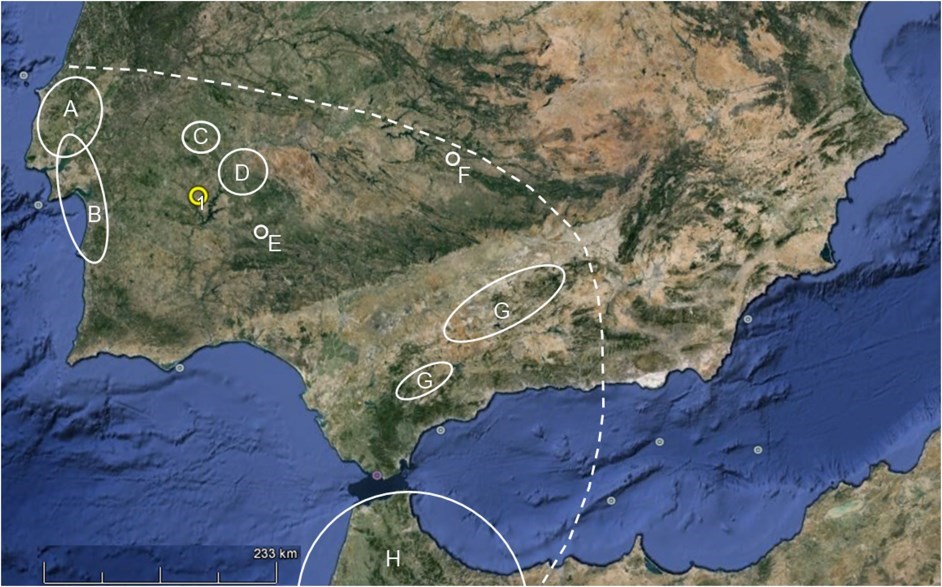
Area of interaction of Perdigões. Image taken from VALERA,
A.C. (no prelo), “The “exogenous” at Perdigões. Approaching interaction in the
late 4th and 3rd millennium BC in Southwest Iberia”. Proceedings of the Meeting Resource Cultures (June 2015), Alcalá de
Henares/Madrid.
It is clear
that ditched enclosures present significant differences between them: size,
location, temporality, complexity, etc. So, if at a very general scale they can
be addressed as a whole, sharing some general principals, it remains to be
established by research if they correspond to a useful formal category. We can
talk about religious architectures, but putting cathedrals, monasteries and
small chapels in the same bag is not particularly useful for understanding the
historical processes of Christianity. They played structural different social,
cultural, political, symbolic and economic roles in those processes.
Regarding the
Portuguese prehistorical enclosures one significant difference (that can be
extended to the southern Spanish ones) is the evidence for interaction. This evidence is intense in the large ditched enclosures and scarce or absolutely absent
in smaller enclosures, according to actual available data. For instance Perdigões
has a significant amount of exogenous materials squandered in funerary contexts that
show relations with the entire Southwest quarter of Iberia and North Africa, while
the neighbours smaller enclosures of Montoito, Torre do Esporão or Luz 20 do not
present evidences of such interaction or evidences that they were stages for
funerary practices. And we could extend these differences to temporality,
intensity and periodicity of construction, evidences of rituality and feasting,
etc.
Are these
differences corresponding just to a variability range inside a coherent category
of “ditched enclosures”? Or are they showing us a category enclosing different
historical entities sharing some general structural principles (that are also
shared with other architectures of the time), but that played significant different
historical roles? Are the differences of scale and complexity only quantitative
or also qualitative? Those are not axioms, they are questions for research.
Etiquetas:
aa_Ditched enclosures,
Interaction,
Perdigões
Sunday, April 3, 2016
0341 - Brasilian (Proto) Jê enclosures come to Enclosing Worlds
The brasilian Jê enclosures will be present at the meeeting Enclosing Worlds, where the enclosing phenomena will be discussed by confronting different historical situations and trajectories from different parts of the world. You may see the abstracts as they are being progressivelly dislayed at http://enclosingworlds.blogspot.pt/p/abstracts.html.
Etiquetas:
aa_Ditched enclosures,
aa_Walled enclosures,
Scientific Reunions
Tuesday, March 29, 2016
Friday, March 25, 2016
0339 - And another paper on Portuguese Ditched Enclosures
Now about the relations of those sites with funerary contexts at several scales (from cosmology and landscapes to specific funerary structures). It is available in Academia and Research Gate.
Etiquetas:
aa_Ditched enclosures,
Funerary practices,
Publications
Sunday, March 20, 2016
Friday, March 18, 2016
0337 - Enclosures, Identity and heritage: The Fraga da Pena case.
Fraga da Pena (Fornos de Algodres, Guarda) was discovered for Archaeology by me (and two “Isabels”) in 1991. Between that year and 1998 I excavated the site and produced a scientific discourse about it (part of my PhD thesis). It is now an important context in Portuguese archaeology regarding the bell beaker phenomena and the late 3rd millennium BC, as well as for the debate regarding enclosures in Iberia.
That work
gave way to a project of public display that tried to bring the site back to a
socially active role (see here what was done). Today, it is used as the main
banner of the Municipality page on Facebook (where we can read “A history that
touch us”) and its profile is in the logo (left side) of the municipality (curiously with
the representation of the sun, something that might have been important in the
site’s role in Prehistory (see here).
I am happy.
The Fraga is back as a meaningful place and not just for archaeologists. Job
done. My thanks to all that have contributed to this, and they were many: from
Portugal (obviously the majority), Spain, Czeck Republic, Hungary, Turkey, France, Belgium, USA, Norway,
Wales, Poland…
Etiquetas:
aa_Walled enclosures,
Fraga da Pena,
Public
Thursday, March 17, 2016
0336 - Big, but maybe not so big
One of the
issues to be discussed today at Oporto meeting about enclosures and
methodologies: the need for complete plans in order to interpret these sites.
Especially those that seem to be enormous: Being huge, recent data regarding
large plans suggest that they might not be so big. The surface distributions
might rather correspond to successive constructions through time that have
lateral displacements, giving the perception of sites bigger than they in fact
were.
Monday, March 7, 2016
0335 - The twilight of enclosures
A paper that was recently published about the trajectory of ditched enclosures in western Iberia:
Here are the Final Remarks:
However, the abrupt disappearance of enclosures in the last centuries of the 3rd millennium BC is suggesting that some event-like situation may have interfered with that trajectory of social change, but the archaeological record, namely the anthropological one, do not show signs of clear generalized conflict or disease and evidence of climate changes significant enough to be responsible for triggering structural social changes are not suggested by the scarce available palaeoenvironmental data. An environmental impact in the last centuries of the 3rd millennium may not be ruled out, but is not yet demonstrated in this region and especially would not justify the social changes already in course (like the structural ideological changes behind the progressively substitution of collective burials by individual ones). It could however help to understand a sudden demographic break down, a reorganization of settlement patterns and territorialities and a temporary collapse of large scale trade networks. But why enclosures, namely the ditched enclosures, were built no more? For that we must have a cultural answer: the social reasons that were behind their appearance and development (and that were related to the Neolithic cosmologies and to the ways they embodied the social life – Valera, 2012b) were no longer there in the first half of the 2nd millennium BC. Immanent social developments and external environmental causes may be combined to explain the abrupt changes and the outcome observable at the beginning of the 2nd millennium BC, but the relative weight of each element is difficult to evaluate at the moment.
There is also the question of the divergent trajectories presented by some walls enclosure in the Center and North Portugal, namely Zambujal, Castanheiro do Vento and Castelo Velho, where these sites remain occupied and wall construction continues. It is not clear, however, if this traduces in fact continuity or if the occupations present different characteristics and are in some way integrated in new forms of territorial organization. In fact, these continuities are the exception, not the rule and like in the South, changes in several dimensions of the social organization can be appreciated by the beginning of the 2nd millennium: the abandonment of the practice of collective burials, the end of the production of iconographic materials, the decay of large scale trade networks, a profound transformation of the ceramic equipment and an increase of the production of metal weaponry frequently associated to individual status is also documented, especially in Estremadura. So it is not totally clear if the continuity of the occupation with building activity in some walled enclosures is traducing different regional socio-economic trajectories or just local and punctual peculiarities of a more general trend of social change.
In spite of the significant developments of the last decades in the research of social complexity in the Late Neolithic and Chalcolithic of western Iberia, there is still missing important and consistent information about what happened in the last quarter of the 3rd millennium BC and about the nature of the break of the previous social trajectories. Answers, therefore, have been relaying essentially in the logical formats of theoretical models, frequently with weak empirical support. Interdisciplinary research specifically orientated to this problem is needed, namely to obtain well dated and characterized site occupations of the last quarter of the 3rd millennium BC, to appraise the population of the period in demographic terms and to adequately evaluate and measure climate trends, before we can more confidently talk about this process of social change."
Valera, A.C. (2015), "Social change in the late 3rd
millennium BC in Portugal: The twilight of enclosures". In: H. Meller/R.
Risch/R. Jung/H. W. Arz (eds.), 2200 BC – Ein Klimasturz als Ursache für den
Zerfall der Alten Welt? 2200 BC – A climatic breakdown as a cause for the
collapse of the old world?. 7. Mitteldeutscher Archäologentag vom 23. Bis 26.
Oktober 2014 in Halle (Saale). 7th Archaeological Conference of Central Germany
October 23-26, 2013 in Halle (Saale). Tagungen des Landesmuseums für
Vorgeschichte Halle 13,1–2 (Halle [Saale].
Bela Vista 5. One of the latest ditched enclosures of western Iberia 3rd Millennium BC.
Here are the Final Remarks:
"In Portugal,
especially in the Centre-South, the end of the 3rd millennium BC
also marks the terminus of the social path that was developing since the Late Neolithic.
Is this a direct consequence of a climate break down, of incompatibilities of
the global social system or both?
What
follows immediately at the beginning of the 2nd millennium BC shows
that the operated change was of structural scale, affecting the social and the
economic, but also the ideological, the cosmological and the ontological
dimensions of communities, their ways of organizing the territories and building
meaningful landscapes (as it happens with the enclosures of Perdigões and the
megalithic monuments in the Ribeira do Álamo valley) and, most probably,
affecting their demographic composition. Some of those changes can be traced
back to the third quarter of the 3rd millennium BC, namely the
increase of social differentiation and a progressive emergence of individuality
in funerary practices. But during that second half of the millennium
enclosures, one of the emblematic expressions of Neolithic trajectories, maintain
their social role and through their architectures and social practices, were
still organizing the landscapes and the social life. So structural changes were
in course during the second half of the 3rd millennium BC and these
changes cannot be explain by hexogen conditions to the social system.However, the abrupt disappearance of enclosures in the last centuries of the 3rd millennium BC is suggesting that some event-like situation may have interfered with that trajectory of social change, but the archaeological record, namely the anthropological one, do not show signs of clear generalized conflict or disease and evidence of climate changes significant enough to be responsible for triggering structural social changes are not suggested by the scarce available palaeoenvironmental data. An environmental impact in the last centuries of the 3rd millennium may not be ruled out, but is not yet demonstrated in this region and especially would not justify the social changes already in course (like the structural ideological changes behind the progressively substitution of collective burials by individual ones). It could however help to understand a sudden demographic break down, a reorganization of settlement patterns and territorialities and a temporary collapse of large scale trade networks. But why enclosures, namely the ditched enclosures, were built no more? For that we must have a cultural answer: the social reasons that were behind their appearance and development (and that were related to the Neolithic cosmologies and to the ways they embodied the social life – Valera, 2012b) were no longer there in the first half of the 2nd millennium BC. Immanent social developments and external environmental causes may be combined to explain the abrupt changes and the outcome observable at the beginning of the 2nd millennium BC, but the relative weight of each element is difficult to evaluate at the moment.
There is also the question of the divergent trajectories presented by some walls enclosure in the Center and North Portugal, namely Zambujal, Castanheiro do Vento and Castelo Velho, where these sites remain occupied and wall construction continues. It is not clear, however, if this traduces in fact continuity or if the occupations present different characteristics and are in some way integrated in new forms of territorial organization. In fact, these continuities are the exception, not the rule and like in the South, changes in several dimensions of the social organization can be appreciated by the beginning of the 2nd millennium: the abandonment of the practice of collective burials, the end of the production of iconographic materials, the decay of large scale trade networks, a profound transformation of the ceramic equipment and an increase of the production of metal weaponry frequently associated to individual status is also documented, especially in Estremadura. So it is not totally clear if the continuity of the occupation with building activity in some walled enclosures is traducing different regional socio-economic trajectories or just local and punctual peculiarities of a more general trend of social change.
In spite of the significant developments of the last decades in the research of social complexity in the Late Neolithic and Chalcolithic of western Iberia, there is still missing important and consistent information about what happened in the last quarter of the 3rd millennium BC and about the nature of the break of the previous social trajectories. Answers, therefore, have been relaying essentially in the logical formats of theoretical models, frequently with weak empirical support. Interdisciplinary research specifically orientated to this problem is needed, namely to obtain well dated and characterized site occupations of the last quarter of the 3rd millennium BC, to appraise the population of the period in demographic terms and to adequately evaluate and measure climate trends, before we can more confidently talk about this process of social change."
Etiquetas:
aa_Ditched enclosures,
Publications,
Theoretical approaches
Wednesday, February 24, 2016
0334 - Human remains in ditches at Porto Torrão
The
revision that is being done to materials from the excavations of Era
Arqueologia in Porto Torrão is providing new information.
As in other
ditches of the site, the Chalcolithic ditch 2 has also human remains deposited
together with faunal remains and other archaeological materials.
The
deposition of scattered human remains in ditches is a practice that is being
more and more frequent in Iberian large enclosures, such as Perdigões,
Valencina de la Concepción, Pijotilla and naturally Porto Torrão. Something
that is well known in European ditched enclosures, confirming social practices
that have a wide distribution, possibly related to shared cosmologies at a
large scale.
Etiquetas:
aa_Ditched enclosures,
Funerary practices,
Porto Torrão
Tuesday, February 23, 2016
0333 - Excavating at Montoito ditched enclosure
The excavation has identified a ditch with the V shape, 3 meters wide and 3 deep, cut in the bedrock at a ratio of 1:1. The ceramic collected lets us propose the occupation of the site in the middle of the 3rd millennium BC, or possibly soon after. Thus, the small enclosure ditches of Montoito must have been contemporary of the latest ditches of Perdigões that lies just 8km South.
Rui Mataloto
Monday, February 22, 2016
0332 - New paper on portuguese ditched enclosures
About the large ditched enclosures of Salvada and Monte das Cabeceiras 2 (Beja) and the interesting questions they put by being so close to each other.
Sunday, February 21, 2016
0331 - Meeting about enclosures and methods
In the sequence of the research developed about the subject in NIA-ERA, I'll be participating in a workshop at Oporto University (next March 17th) dedicated to debate the relations between the research of enclosures and methodological options and approaches. Here is the program (in Portuguese):
Recintos peninsulares da Pré-História Recente. Métodos multidisciplinares de investigação.
Thursday, February 11, 2016
0330 - The exhibition of Perdigões: the posters
For those who cannot go to Évora and visit the temporary exhibition about Perdigões ditched enclosures the posters that go along with the archaeological materials may be seen here.
Etiquetas:
aa_Ditched enclosures,
Exhibitions,
Perdigões
Monday, February 8, 2016
0329 - Enclosing is organizing the world
Creating
borders, opposing spaces with different meanings: the organization of space is an expression
of human forms of cognition. Enclosing is a structural phenomenon, a way of
thinking and organizing the world that cannot be reduced to a defence strategy.
Tuesday, February 2, 2016
0328 - Perdigões in Évora next week
Perdigões: an aggregation centre in Prehistory
and in the Present
15.00 – 16.00
Perdigões:
a synthesis of 18 years of research of an exceptional site
António
Carlos Valera
16.30 – 17.30
The display
of Perdigões: limitations and potentials
Miguel Lago
The
anthropological record of Perdigões: evaluation from the case study of tomb 1
Lucy Shaw Evangelista
The faunal
record of Perdigões: data from the study of 15 000 studied bones.
Cláudia Costa
The
research of ditched enclosures in Portugal: reasons for the exceptional status
of Perdigões.
António Carlos Valera
Etiquetas:
aa_Ditched enclosures,
Perdigões,
Scientific Reunions
Friday, January 29, 2016
0327 - Abstracts for the meeting Enclosing Worlds
You may check the abstracts here.
Etiquetas:
aa_Ditched enclosures,
aa_Walled enclosures,
Scientific Reunions
Sunday, January 17, 2016
0326 – Portuguese ditched enclosures in intercontinental project
After obtaining the approval and funding for a FCT project on mobility, the enclosure of Perdigões (but also others that were researched by Era Arqueologia, like Bela Vista 5 and Porto Torrão) will be part of an intercontinental research project on prehistoric mobility. The project, titled “Beyond migration and diffusion: The prehistoric mobility of people & ideas”, is funded by the Australian Research Council and has a leading team composed by Catherine Frieman, Rainer Grun, Matthew Springgs, Rachel Wood (from Australian National University), Mathieu Duval (from Centro Nacional de Investigación sobre Evolución Humana, Spain) and António Valera (Era Arqueologia, S.A.).
The main goal is to see how the movement of individuals and groups of people is both an instigator and a response to sociocultural change, utilizing both key European and Pacific Island examples to help build a truly comparative archaeology of rapid social and economic change, with pertinence to general theories of innovation and adoption.
Etiquetas:
aa_Ditched enclosures,
Bela Vista 5,
Perdigões,
Porto Torrão
Subscribe to:
Posts (Atom)